 Български
 Čeština
 Dansk
Dansk Deutsch
 Ελληνικά
 English
 Español
 Eesti
Eesti Suomi
Suomi Français
 Magyar
 Italiano
 Lietuvių
 Latviešu
 Norsk
Norsk Nederlands
 Polski
 Português
 Română
 Slovenčina
 Slovenščina
 Svenska
 Русский
 Українська
 Türkçe


After the installation...
... The first step should be to register or transfer an existing registration. This is essential for creating documents.
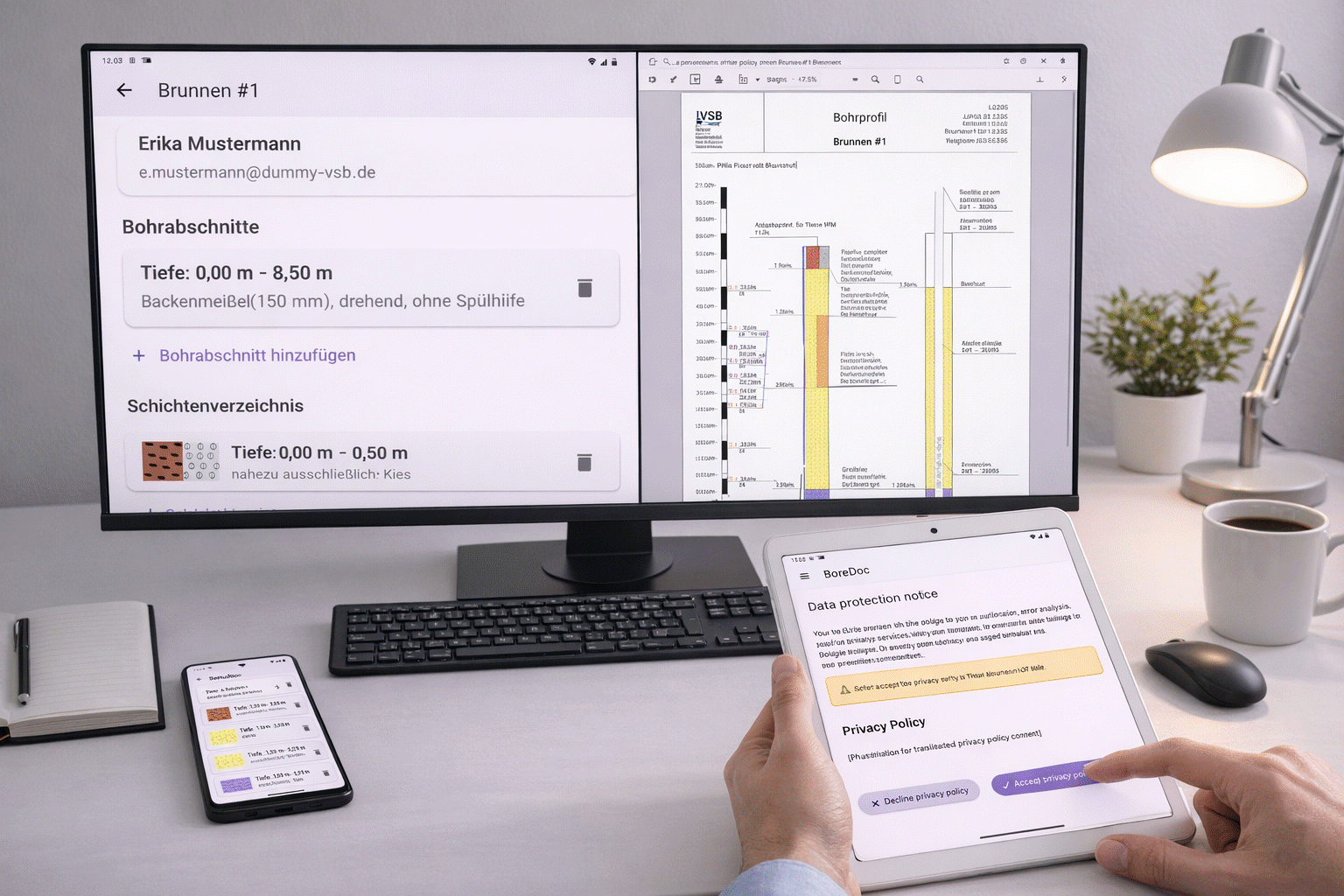
With BoreDoc, you can record drilling data directly on site - structured, mobile and without paperwork. The app creates print-ready reports, also works offline and protects your data in accordance with the GDPR.
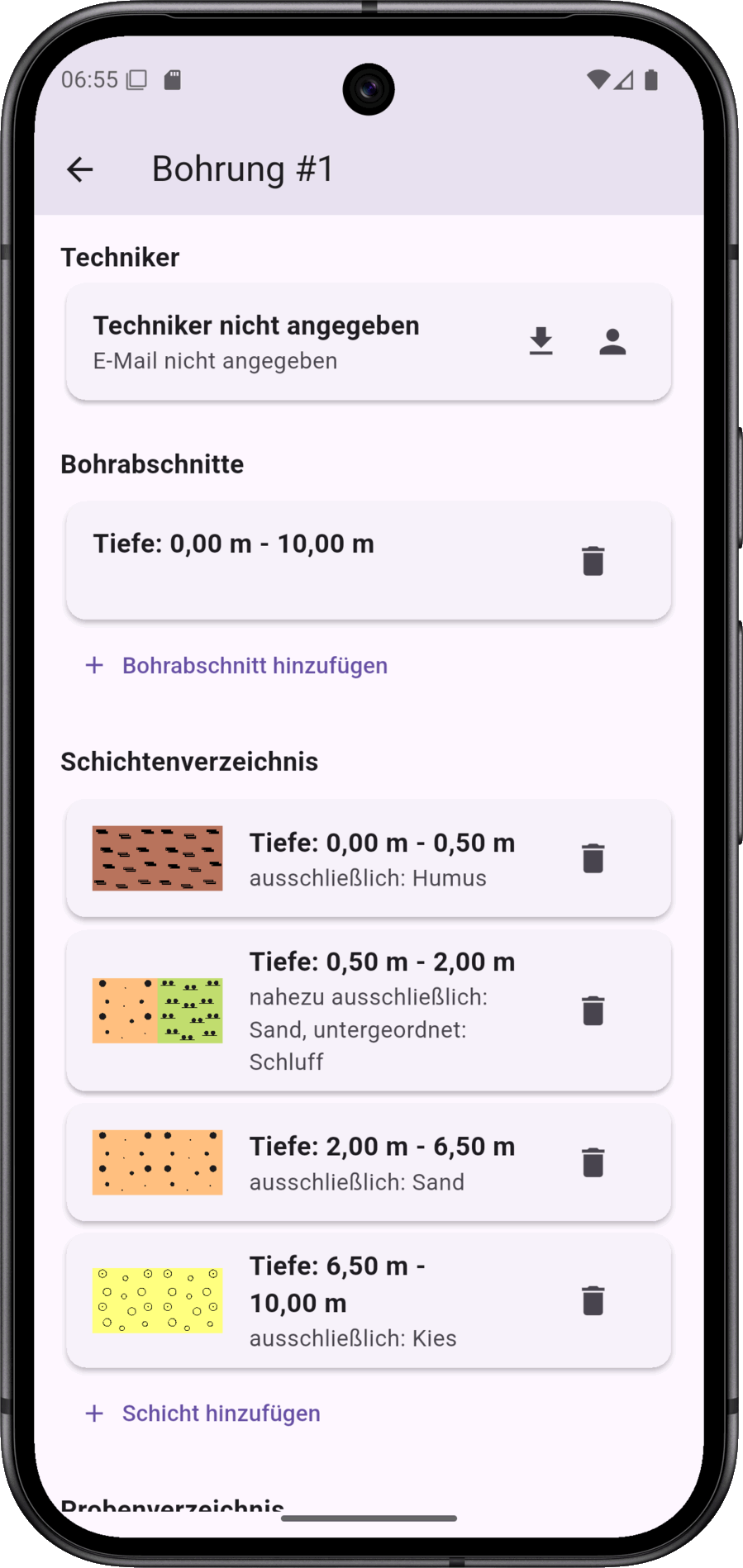
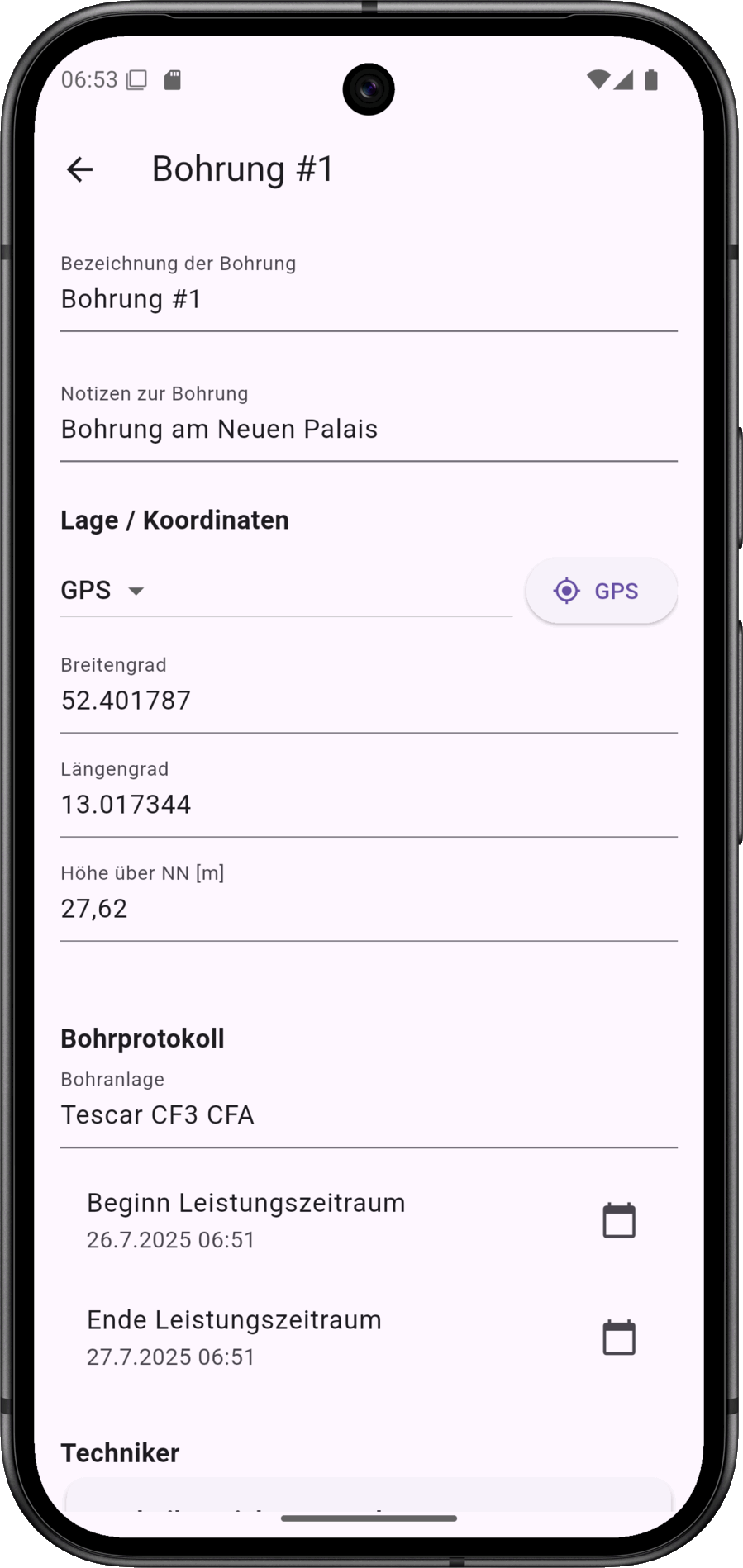
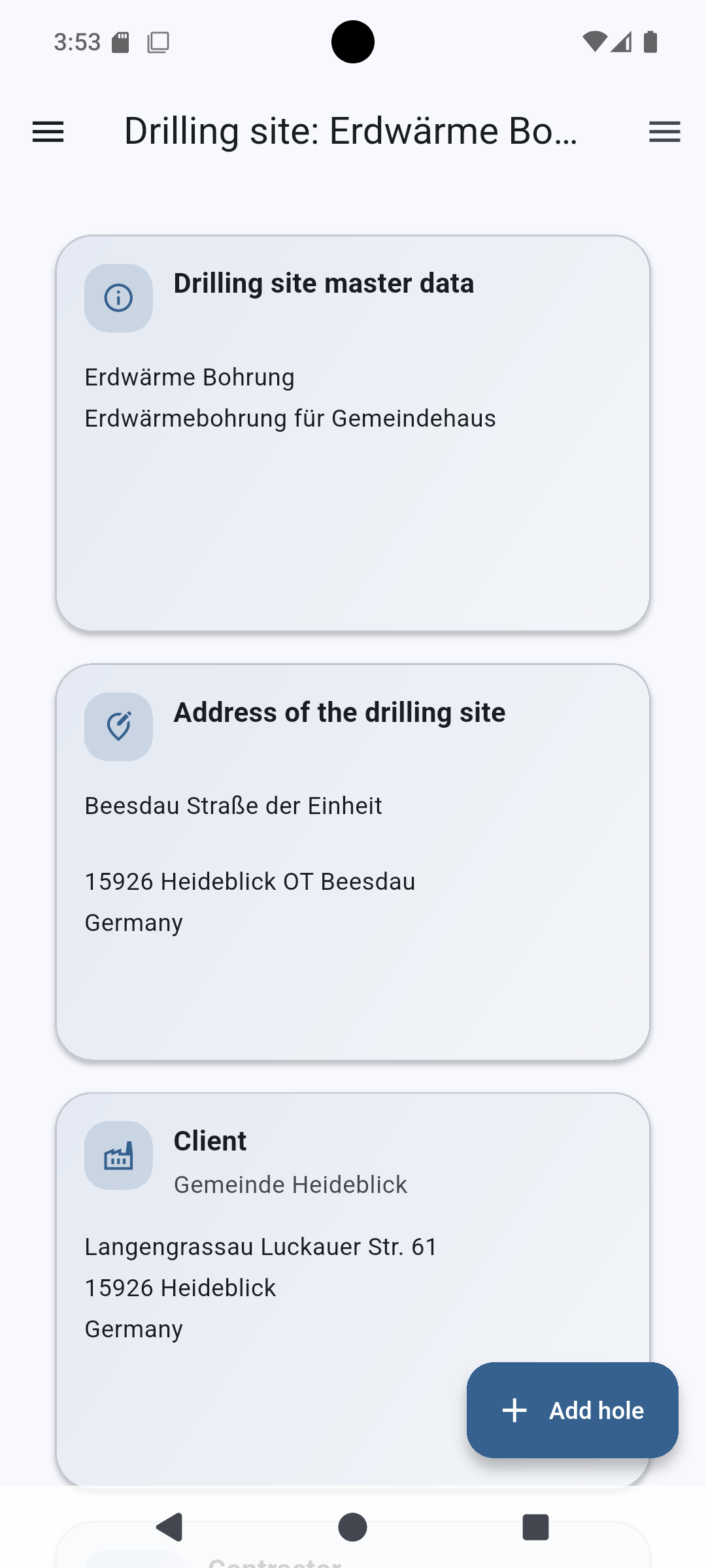
BoreDoc is available as an Android app for tablets and smartphones via the Google Play Store offered.
An installation package for Microsoft Windows is now also available. In future, BoreDoc will be made available via the Microsoft Store, which has the advantage of automatic updates. You can download the installation package at BoreDoc Downloads download.
In addition, a Brower version for (Chrome, Firefox, Edge, Safari), which is well suited for testing and short-term use. For long-term stable use - especially with regard to local data storage and controlled updates - the app version is recommended.
... The first step should be to register or transfer an existing registration. This is essential for creating documents.
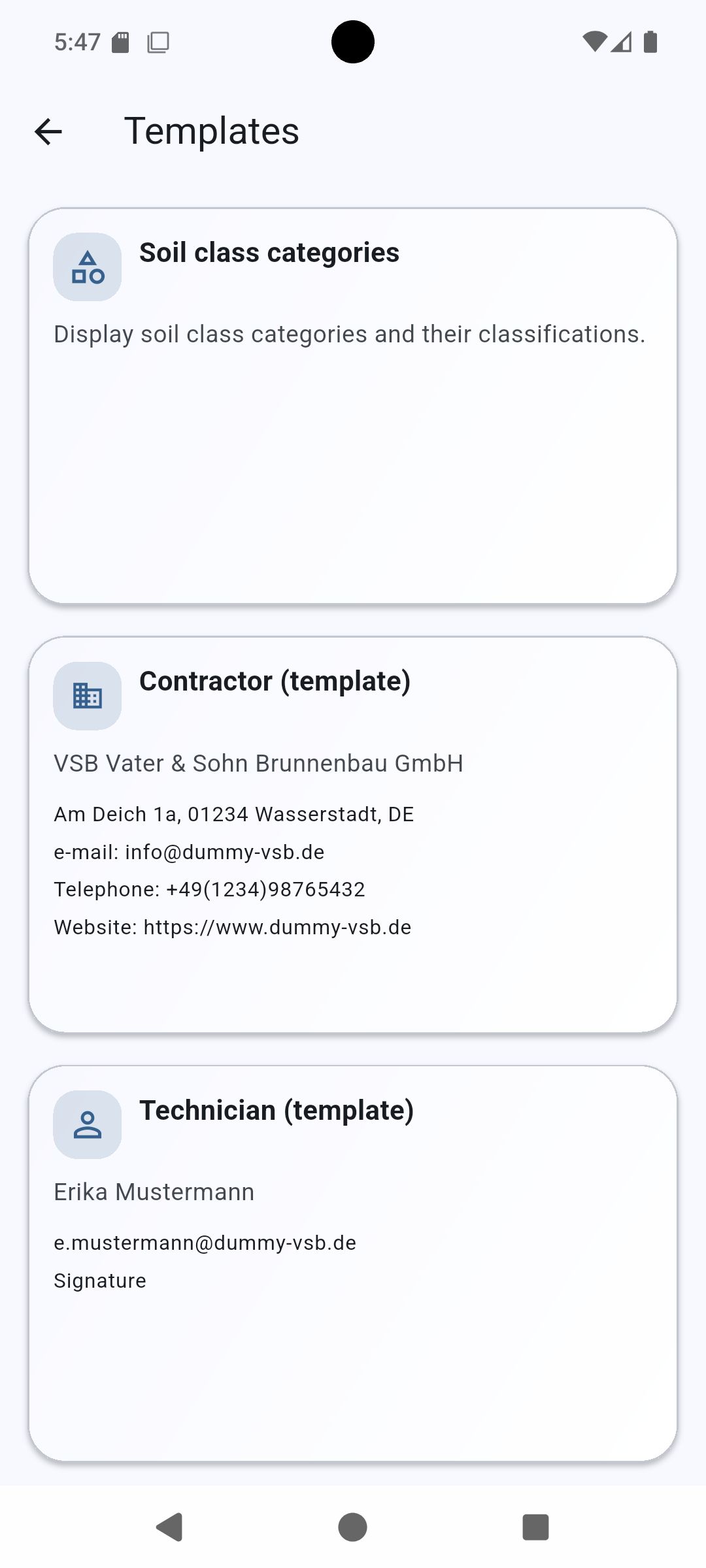
Completed templates for contractors and technicians speed up the entry of repetitive information in the input process. If the templates are not filled in, a message is displayed on the start screen.
A drilling site includes master data, such as client and contractor, as well as several boreholes.
The context menu (sandwich icon top right) for the drilling site is also located here.
A borehole includes the usual data, such as name/designation, geo-coordinates, drilling log (execution period, technician, drilling sections, equipment used).
In addition, the borehole can be labelled with information on the soil layers, soil samples, water levels, backfilling and the development. Not all information is mandatory.
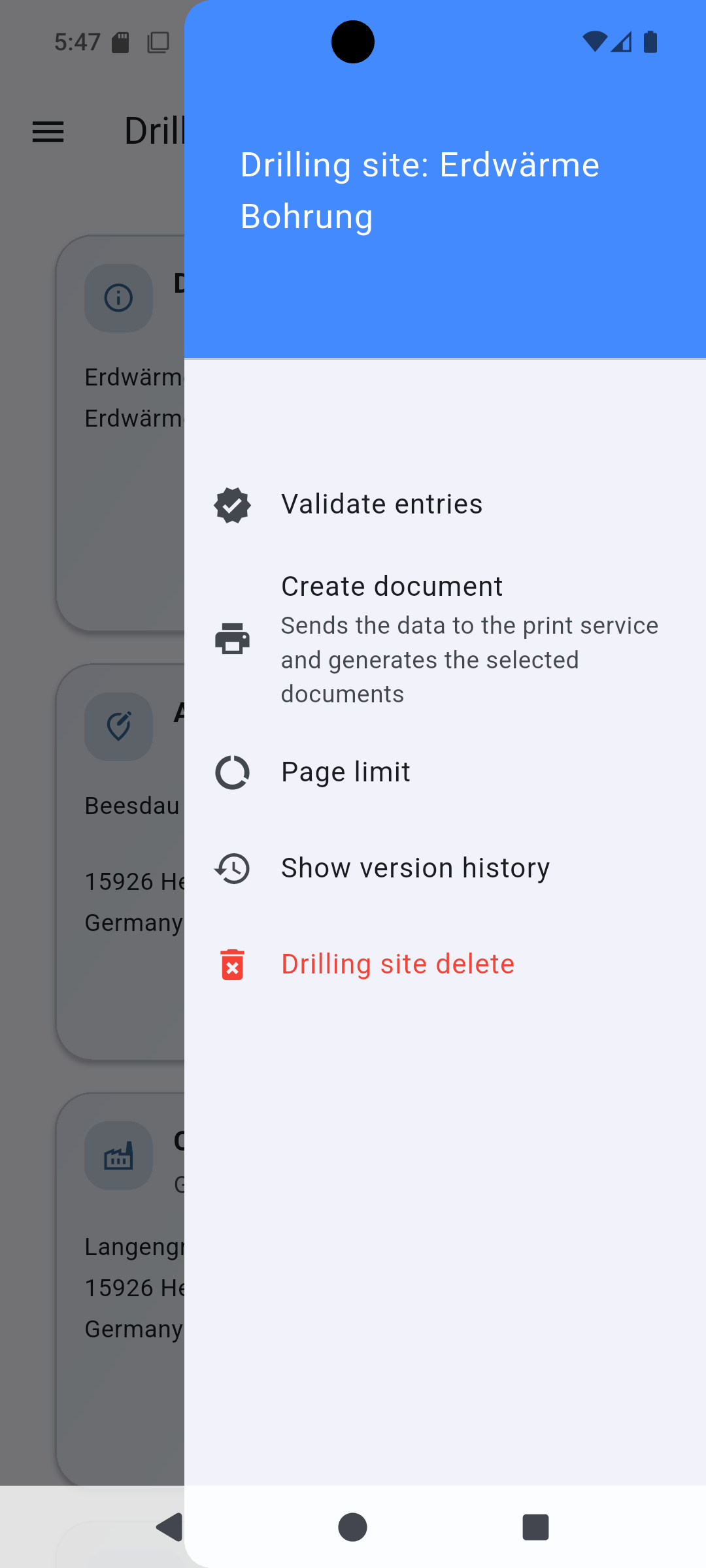
The context menu for the drilling site contains various functions, such as validating the entered data and triggering document generation.
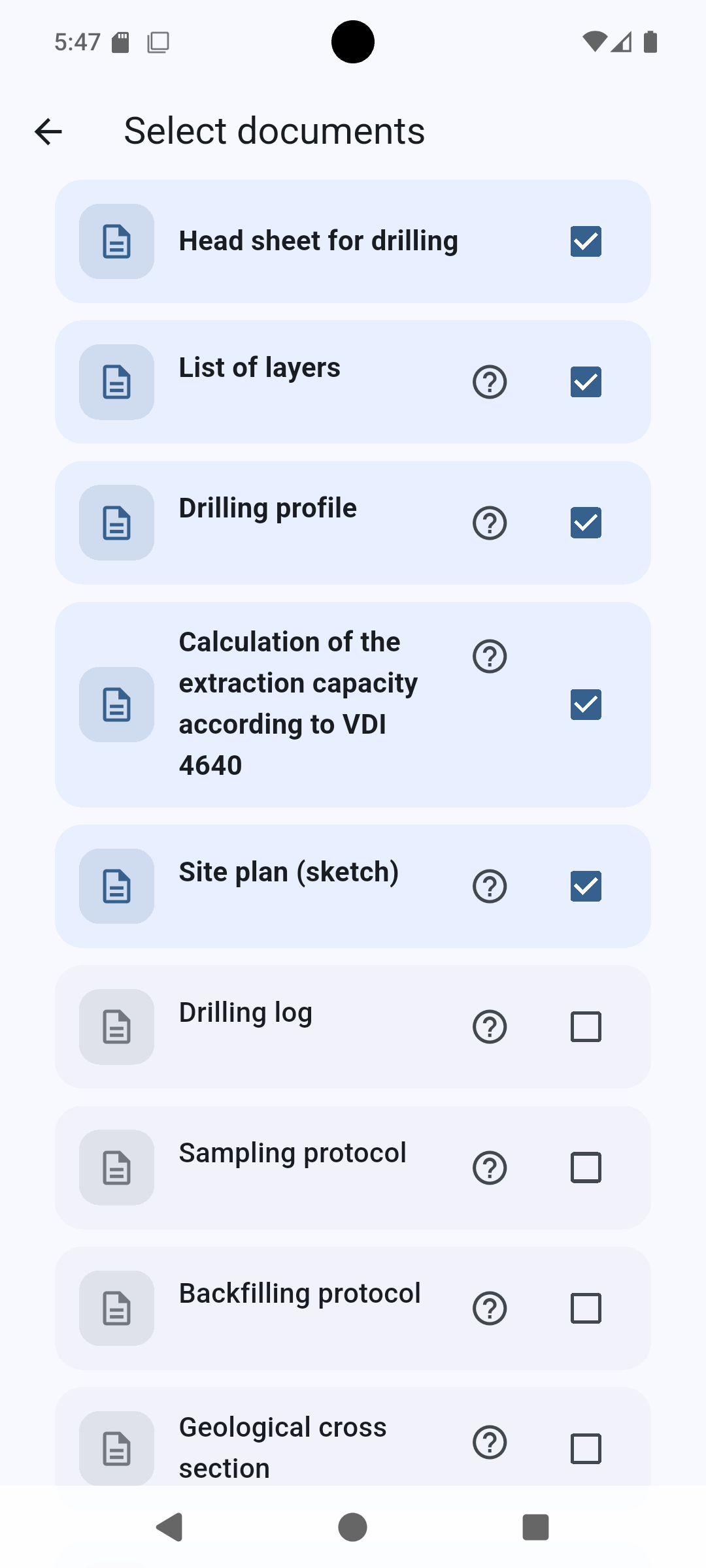
In the first step of validation, the documents to be generated are selected. These include the following: Stratigraphic log, drilling profile, drilling log, sampling log, geological section and others.
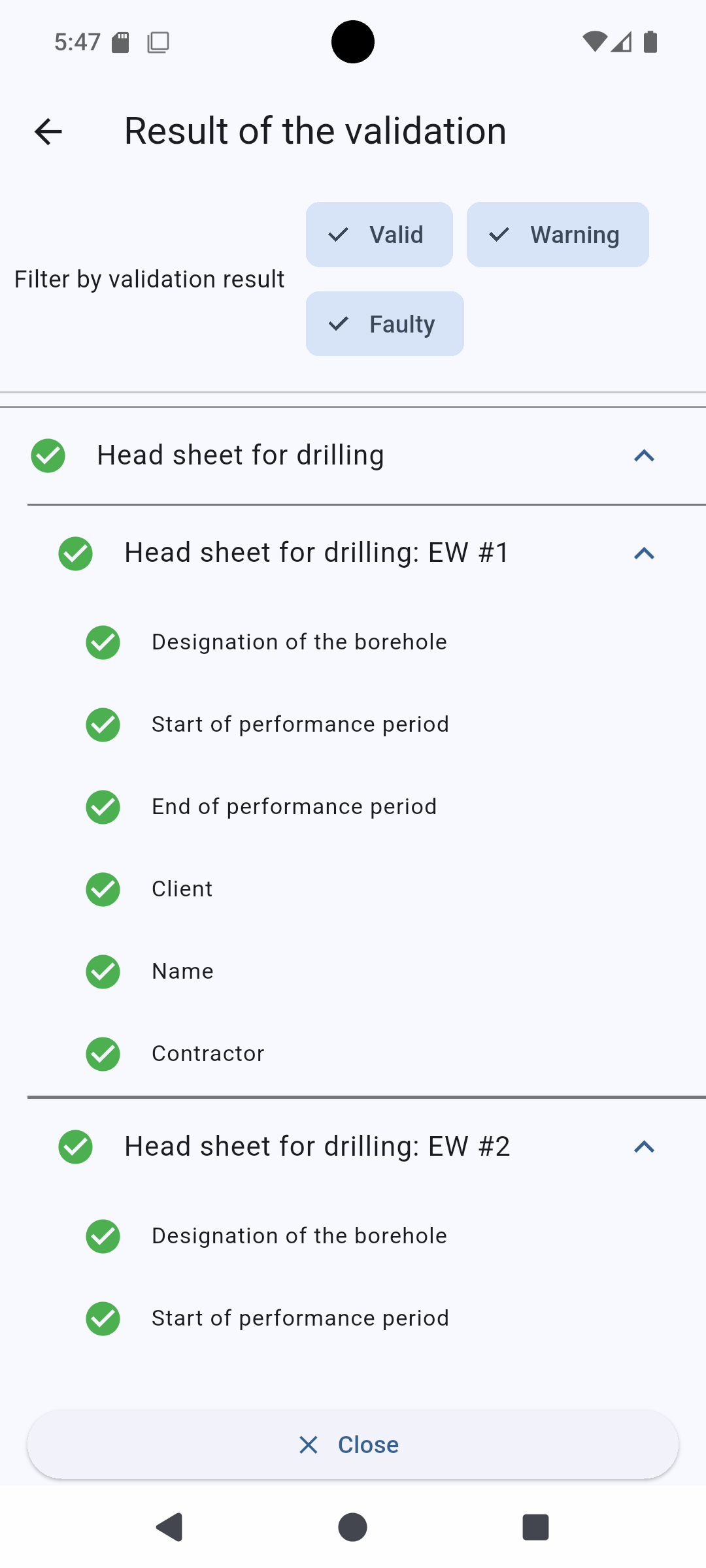
The validation result distinguishes between errors, warnings and valid. Warnings can be understood as hints. Example: Removal in the drilling profile is not possible if no information on backfilling has been provided.
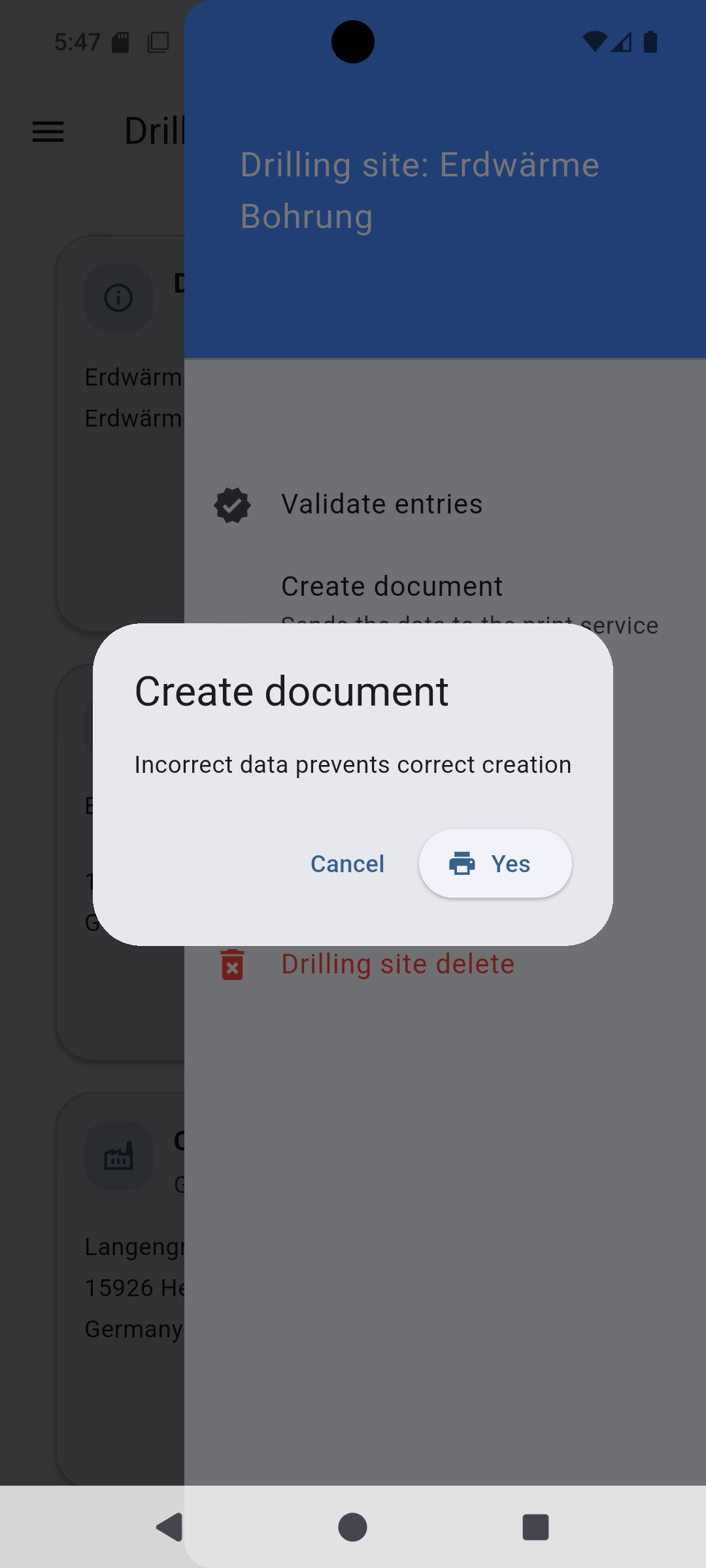
This function is available online.
By requesting a document, the data from the drilling site is sent to the server, where the documents are generated. Depending on the connection speed, the process takes 5 to 20 seconds.
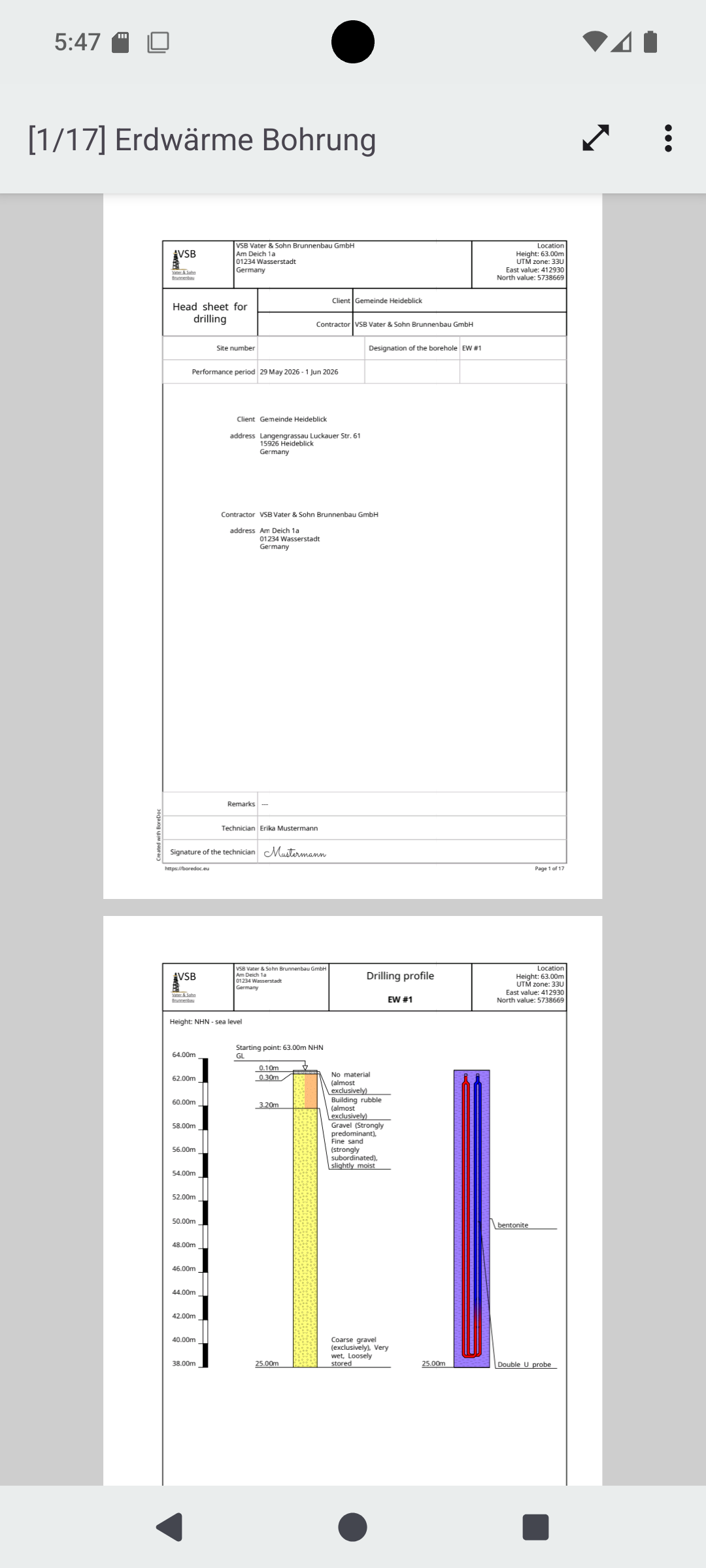
The documentation generated for the drilling site is transferred to your device as a PDF. You will need an appropriate display programme to view the document.
You can currently use BoreDoc completely free of charge. Our current focus is on further developing the functions together with our users and optimising them for practical use. A binding pricing model will be introduced at a later date. Until then, you can benefit from all the advantages without restrictions and without hidden costs.
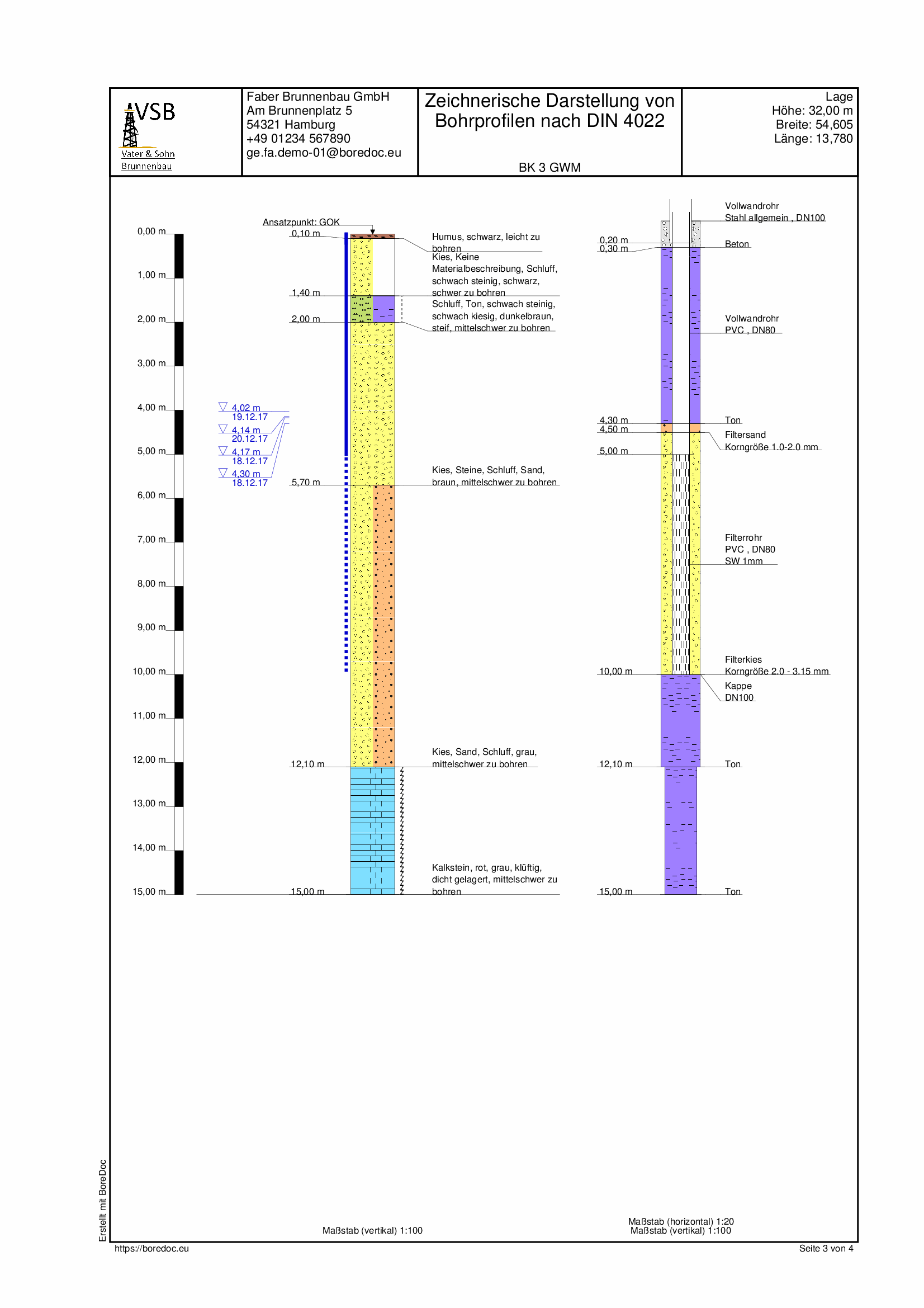
A borehole profile is the graphic realisation of the sequence of layers recorded during a borehole. It supplements the textual documentation with a clear visualisation that makes the subsurface visible in its vertical structure. This makes it possible to recognise at a glance which layers occur in which order, how thick they are and at what depth they lie. The aim is to make geological information clearly and directly accessible.
The representation is usually a vertical section in which each layer is clearly identified by symbols, hatching or colours. Depth information at the layer boundaries enables the exact location in the subsurface to be assigned. This creates a visual overview that allows quick orientation, independent of extensive texts. The drilling profile thus becomes an indispensable tool for geological documentation.
In practice, the drilling profile supports engineers, geologists and experts in evaluating the subsoil. It provides information on the load-bearing capacity, groundwater conditions or special risks and facilitates the selection of suitable construction methods. It is also an easy-to-understand basis for clients or authorities to make comprehensible decisions. It thus combines technical precision with a high degree of clarity.
The drilling profile also plays an important role in research. It allows conclusions to be drawn about the formation history of a region, documents geological processes and creates comparability between different locations. In environmental and hydrogeology in particular, it provides crucial information about the layer structure and possible water pathways. The drilling profile thus adds scientific value to its purely technical use.
The creation of drilling profiles is subject to established norms and standards to ensure uniformity and comparability. In particular, DIN 4023 (drilling profile), which regulates the graphical representation, and DIN 4022 (soil and rock characterisation) for the uniform description of layers. In addition, international standards such as ISO 14688 are used to name and classify soils. These standards ensure that drilling profiles can be understood in the same way regardless of location and time.
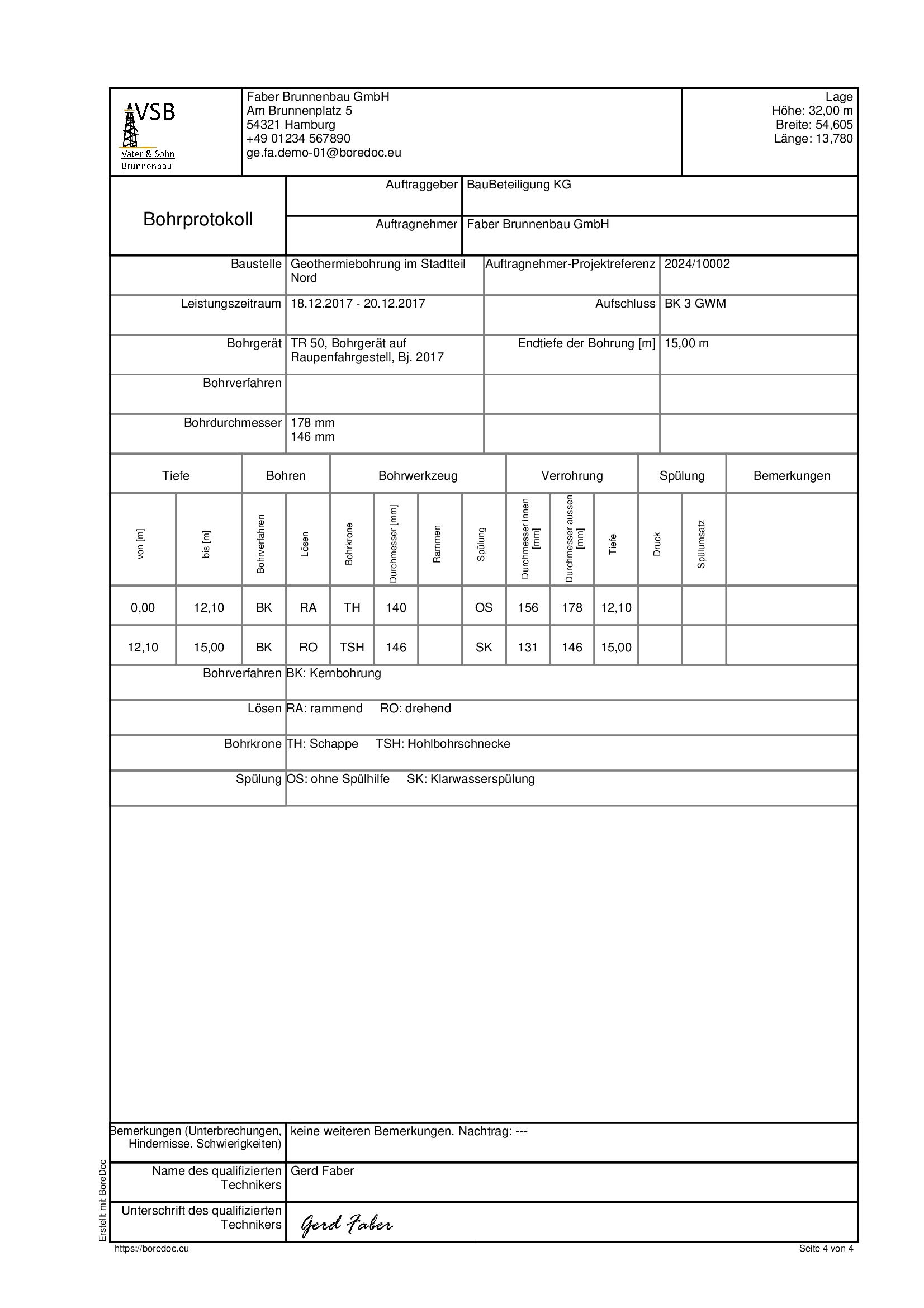
A drilling log is the written basis for all drilling documentation. It records all key steps, observations and general conditions during drilling. This enables complete traceability of the process and ensures the quality of the data collected. The aim is to make the entire process transparent and to keep it reliably accessible for technical, legal and scientific purposes.
Typically, a drilling log contains information on the drilling rig, drilling method, start and end of the work and the depth reached. In addition, aids such as pipework or flushing are documented, as are unexpected incidents or technical difficulties. All data is organised chronologically so that the drilling progress can be tracked. The log therefore not only provides information about the result, but also about the conditions under which it was achieved.
In the construction industry, the drilling log is an important tool for assessing the subsoil and evaluating risks. Engineers and clients can use the documentation to select suitable construction methods and realistically calculate costs. At the same time, it serves as proof for authorities and insurance companies that the work was carried out properly and in accordance with applicable standards. In cases of conflict, it provides a reliable basis for clarification.
The drilling log also plays an important role in geoscientific research. It not only provides data on the layers encountered, but also documents the technical conditions under which these were obtained. This improves comparability with other boreholes and makes scientific statements more meaningful. The drilling log thus combines the practice of civil engineering with the methodology of research.
The formal design of drilling logs is regulated in the relevant standards. The relevant standard is DIN 4021,, which provides detailed specifications for the structure and content of drilling logs. In addition, DIN 4022 applies to the standardised addressing of soils and rocks in order to ensure uniform documentation. ISO 22475, which contains guidelines for geotechnical exploration, sampling and groundwater measurements, is relevant at international level. These standards ensure that drilling logs are technically correct, comparable and legally robust.
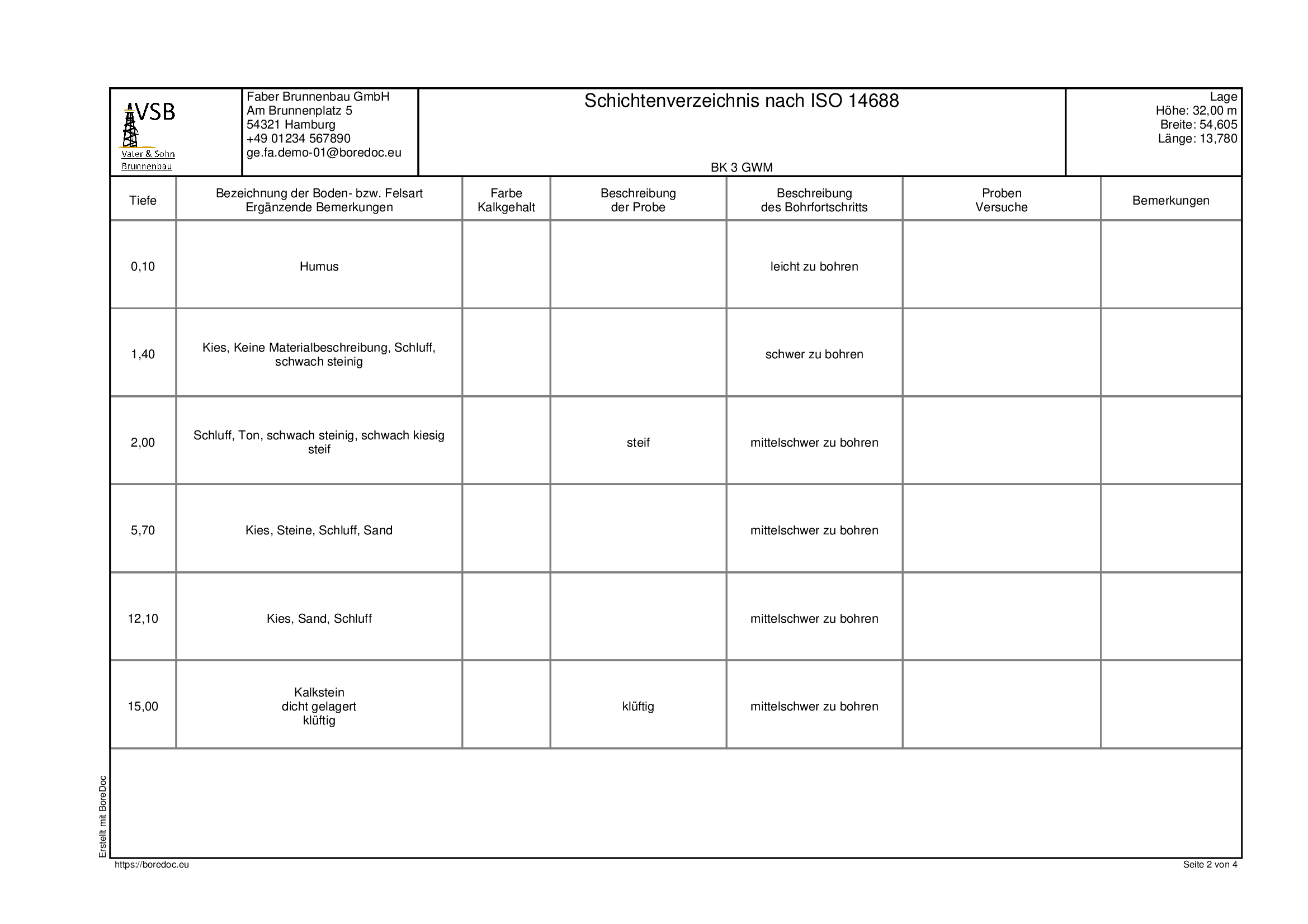
The stratigraphic log is an essential document that is created during drilling to visualise the structure of the subsurface. It summarises the individual layers of earth and rock in the order in which they occur and thus makes the geological structure visible. The aim is to create a structured and comprehensible visualisation that can be used for both technical planning and scientific studies. Without such a catalogue, a reliable assessment of the soil conditions would hardly be possible.
In terms of content, the layer catalogue describes each layer encountered with its typical properties. These include visual characteristics such as colour, but also physical properties such as grain size, plasticity, moisture or strength. Special features, such as organic residues or traces of weathering, are also documented. The exact depth information, which marks the layer boundaries and enables clear spatial categorisation, is also crucial. This systematic recording creates a complete picture of the subsurface at the drilling point.
The importance of the strata catalogue is particularly evident in its practical application. Civil engineers use it to plan safe foundations or select suitable construction methods. It is also an important tool in the field of environmental investigations, as it provides information on groundwater movements or possible pollution. In geoscience, it also serves as a source for better understanding the geological development of a region.
To fulfil its purpose, the layer directory must be created with great accuracy. Each entry helps to create an overall picture that later influences far-reaching decisions. It is therefore not just a technical record, but an instrument that makes knowledge about the subsurface tangible and verifiable.
The standardised preparation of a strata catalogue is supported by relevant standards. Of particular importance is DIN 4022,, which provides detailed specifications for the systematic recording of soil and rock features. In conjunction with DIN 4023, a clear basis is created for the connection between text documentation and graphic visualisation. In addition, ISO 14688, applies, which defines internationally recognised criteria for the naming and classification of soils. This ensures consistent and professional documentation.
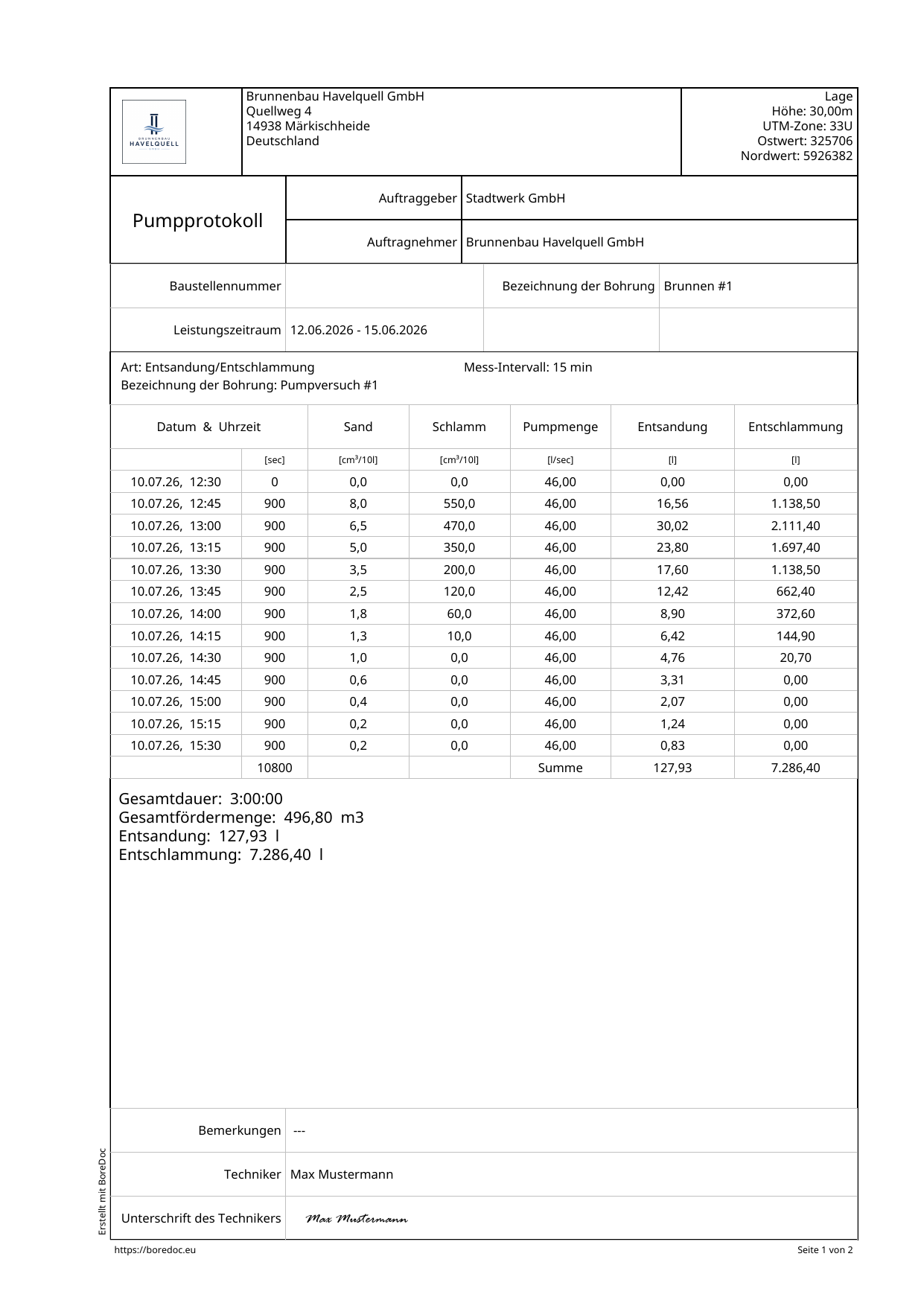
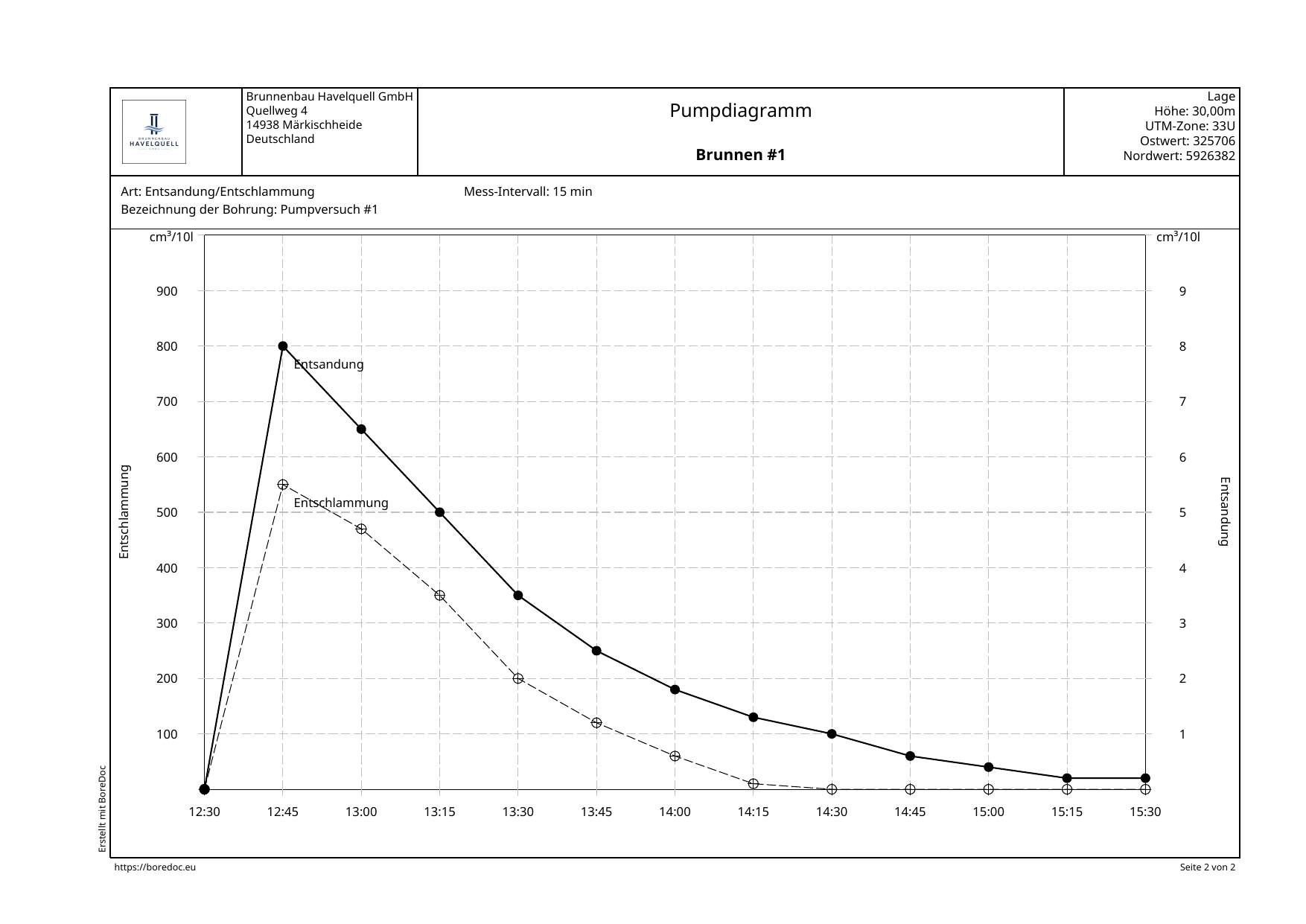
The desanding and desludging report documents how a well is cleared of settled sediments in order to expose the filter section once again and ensure a consistently sand-free water supply. It tracks the progress of the operation based on flow rate and sand and silt content, thereby providing a reliable basis for assessing the success of the cleaning process. The document is particularly suitable for wells where a verifiable cause needs to be established for loss of flow, turbidity or increased pump wear.
In terms of content, the report comprises the general test data, the measurement interval and a chronologically organised series of measurements covering flow rate, sand removal and sludge removal. This automatically generates a tabular report and a diagram that clearly illustrates the progression of sediment removal. This makes it possible to see how sand and silt loads change over the course of the intervention and when the well is approaching a stable, functional state.
Long text
In practice, desanding and desludging are used to specifically remedy silting and sludging in a well. Silting typically occurs when fine sand from the aquifer penetrates the well via the filter gravel bed and the filter pipes, for example as a result of unsuitable well construction or an excessively high extraction rate. Silting up, on the other hand, is caused by organic suspended solids, algae, bacteria or chemical precipitates such as iron and manganese, which are deposited in the well and within the filter pores.
Pumping out and flushing the sediments cleans the filter section and restores the water flow into the well. This not only reduces wear on the pump caused by abrasive particles, but also improves water quality and restores the system’s performance. For client, operators and specialist contractors, accurate documentation of this procedure is essential, as it provides a clear record of the process, the intensity and the success of the cleaning.
=======
generated_at: "2026-07-27T10:28:12.225059700Z"
---
The desanding and desludging report documents how a well is cleared of settled sediments in order to re-expose the filter section and ensure a sustained supply of sand-free water. It tracks the progress of the operation using flow rates and sand and silt content, thereby providing a reliable basis for assessing the success of the cleaning process. The document is particularly suitable for wells where a verifiable explanation is required for losses in flow rate, turbidity or increased pump wear.
In terms of content, the report includes general test data, the measurement interval and a chronologically organised series of measurements covering flow rate, sand removal and silt removal. This automatically generates a tabular report and a diagram that clearly illustrates the progression of sediment removal. This makes it possible to see how sand and silt loads change over the course of the intervention and when the well is approaching a stable, functional state.
Long text
In practice, desanding and desludging are used to specifically remedy the silting up and sludging of a well. Silting typically occurs when fine sand from the aquifer penetrates the well via the filter gravel bed and the filter pipes, for example as a result of unsuitable well construction or an excessively high extraction rate. Silting-up, on the other hand, is caused by organic suspended solids, algae, bacteria or chemical precipitates such as iron and manganese, which accumulate in the well and within the filter pores.
Pumping out and flushing the sediments cleans the filter section and restores the water flow into the well. This not only reduces wear on the pump caused by abrasive particles, but also improves water quality and restores the system’s performance. For client, operators and specialist contractors, accurate documentation of this procedure is important because it provides a clear record of the process, the intensity and the success of the cleaning.
>>>>>>> branch 'master' of git@github.com:mschulzeondts/boredoc-content.git
In BoreDoc, desanding and desludging are recorded directly within the ‘Field Trials’ section. Master data, technician details and measured values are entered once and automatically consolidated within the document. This eliminates the need for manual post-processing in external templates, and both the report and the diagram remain consistent and up to date even when changes are made. This is particularly crucial for recurring measurement points, as it enables a technically sound evaluation of how sediment loads develop over time.
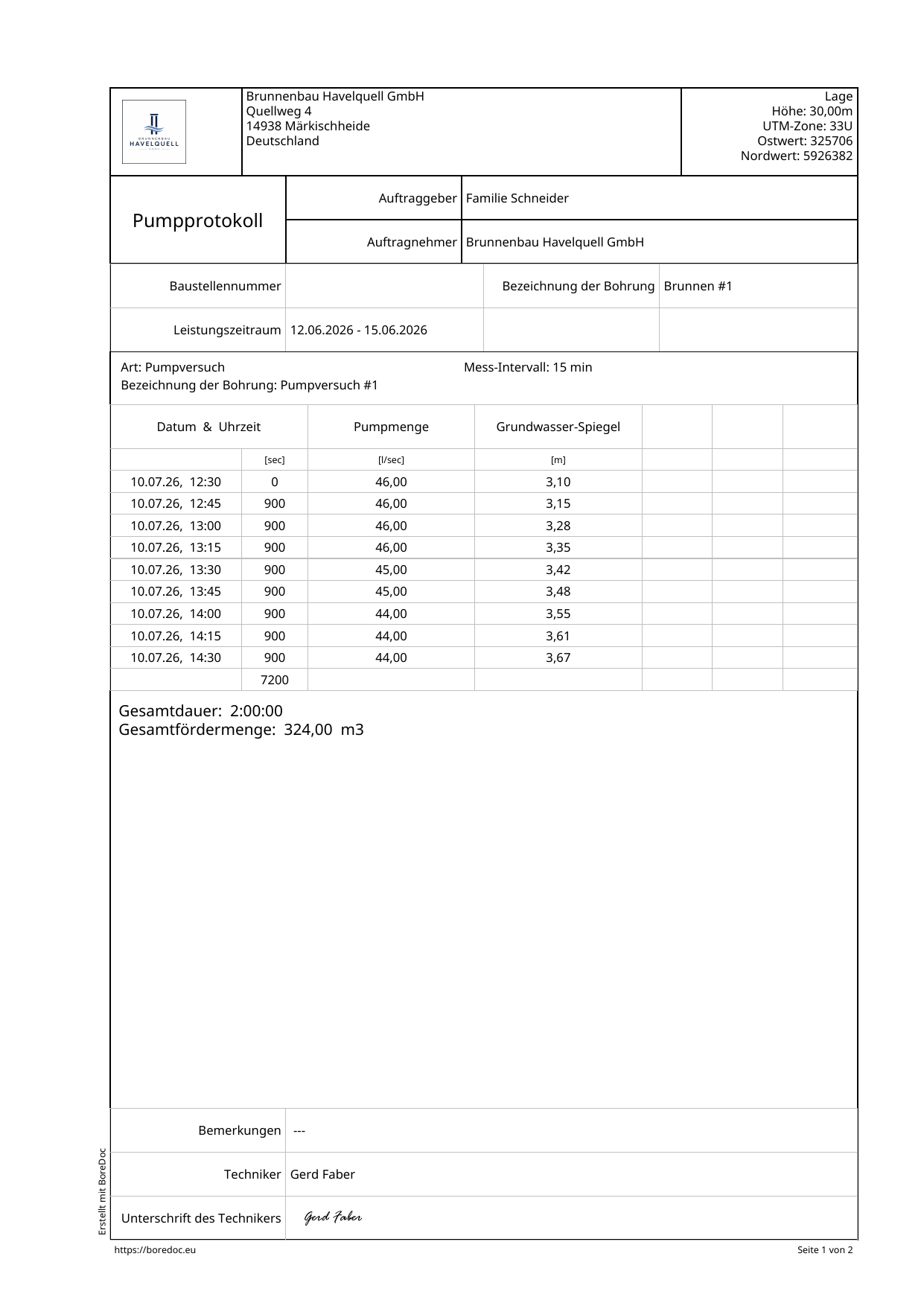
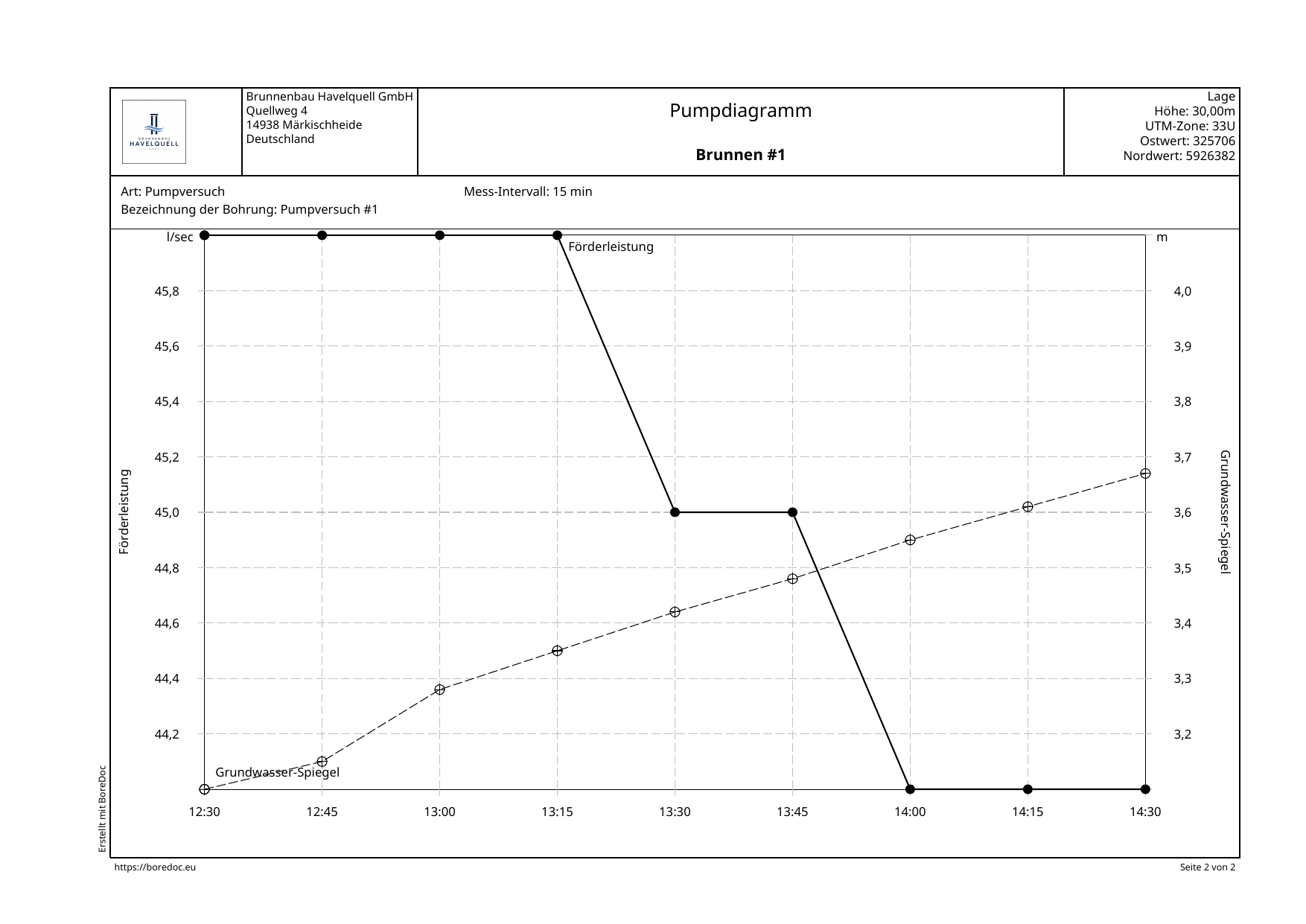
A pumping test to determine well performance shows how the flow rate, water level and drawdown of a well behave under load. The document provides a clear record of the measurement over time and thus offers a reliable basis for assessing the well’s performance. It is suitable wherever the yield, operational behaviour and suitability of a well need to be documented in a verifiable manner.
In terms of content, the pumping test comprises the general test data, the measurement interval and a chronologically organised series of measurements of flow rate and groundwater level. This automatically generates a tabular pumping log and a pumping diagram, which clearly illustrate the course of the performance measurement. This allows changes in the water level, the resulting drawdown and the development of the flow rate to be quickly identified and professionally assessed.
Long text
In practice, a pumping test is used to document the performance of a well under real operating conditions. From a technical perspective, a distinction must be made between hydrogeological pumping tests for determining aquifer parameters and performance pumping tests for assessing well characteristics. For the performance determination shown here, it is particularly relevant to observe how the water level in the well drops under defined or gradually varying pumping rates, and what operational behaviour can be deduced from this. This provides a reliable data basis for decisions regarding the development, utilisation and evaluation of a water extraction point.
In BoreDoc, the pumping test is recorded directly within the ‘Field Tests’ section. Master data, technician details and measurement points are entered once and automatically consolidated within the document. This eliminates the need to manually transfer individual measurement values to external templates, and ensures that the report and diagrams remain consistent and up to date at all times, even when changes are made. This is a significant advantage, particularly for time-dependent measurement series, because the flow rate and water level can only be accurately analysed if all measurement points are documented completely and chronologically.
=======
generated_at: "2026-07-27T10:28:12.891147400Z"
---
A pumping test to determine well performance shows how the flow rate, water level and drawdown of a well behave under load. The document provides a clear record of the measurement over time and thus offers a reliable basis for assessing the well’s performance. It is suitable wherever the yield, operational behaviour and suitability of a well need to be documented in a verifiable manner.
In terms of content, the pumping test comprises the general test data, the measurement interval and a chronologically organised series of measurements of flow rate and groundwater level. This automatically generates a tabular pumping log and a pumping diagram, which clearly illustrate the course of the performance measurement. This allows changes in the water level, the resulting drawdown and the development of the flow rate to be quickly identified and professionally assessed.
Long text
In practice, a pumping test is used to document the performance of a well under real operating conditions. From a technical perspective, a distinction must be made between hydrogeological pumping tests for determining aquifer parameters and performance pumping tests for assessing well characteristics. For the performance determination shown here, it is particularly relevant to observe how the water table in the well drops under defined or gradually varying pumping rates, and what operational behaviour can be deduced from this. This provides a reliable data basis for decisions regarding the development, utilisation and evaluation of a water abstraction point.
In BoreDoc, the pumping test is recorded directly within the ‘Field Tests’ section. Master data, technician details and measurement points are entered once and automatically consolidated within the document. This eliminates the need to manually transfer individual measurement values to external templates, and ensures that both the report and the diagram remain consistent and up to date at all times, even when changes are made. This is a significant advantage, particularly for time-dependent measurement series, as the flow rate and water level can only be accurately analysed if all measurement points are documented completely and chronologically.
>>>>>>> branch 'master' of git@github.com:mschulzeondts/boredoc-content.git
The structured documentation supports a technically sound evaluation of the performance measurement and facilitates subsequent traceability. Timestamps, flow rates and groundwater levels are presented in context, so that the course of the test can be traced not only in tabular form but also graphically. On this basis, typical issues such as yield, maximum drawdown and the behaviour of the well upon reaching a steady state can be assessed transparently.
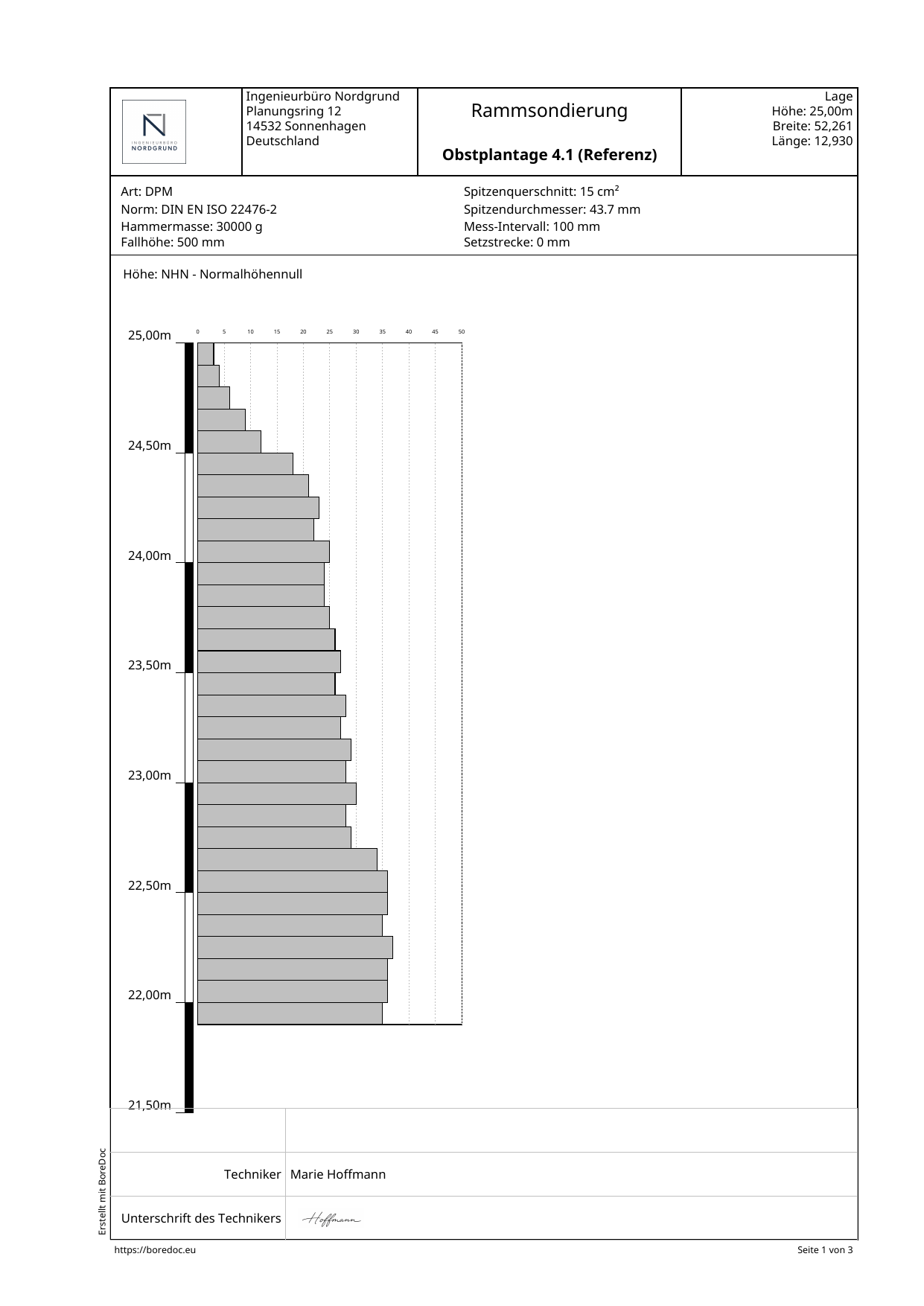
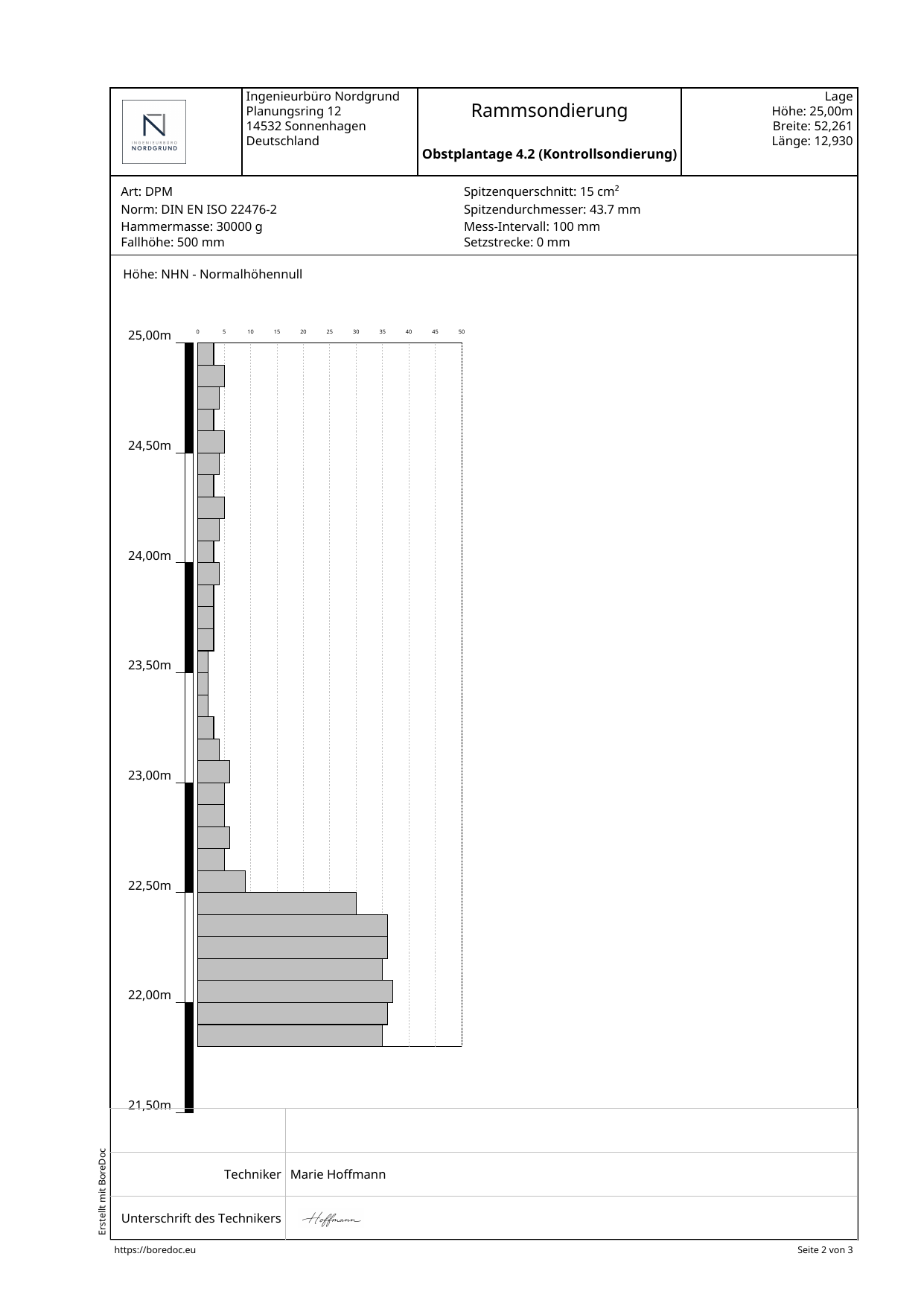
The dynamic probing test is a geotechnical ground investigation method used to provide an indicative assessment of the compaction and bearing capacity of unconsolidated soils. In this method, a probe is driven into the ground with a defined amount of energy, and the number of blows required to reach a specified penetration depth is recorded. The result is a clear representation of the penetration resistance over depth, thereby providing a valuable basis for geotechnical assessments.
In terms of content, the document includes the survey’s master data, the method used, technical parameters such as tip cross-section, tip diameter, hammer mass and drop height, as well as the series of measurements comprising depth and number of blows. From this, a graphical representation of the dynamic penetration test is automatically generated, in which the number of blows is plotted against depth. This allows compaction zones, softer areas and notable changes in the ground profile to be quickly identified.
Long text
In practice, the dynamic penetration test is used to characterise the ground quickly and with relatively little effort. The method is particularly widespread in geotechnical engineering and the construction industry when reliable indications of the compaction density of unconsolidated soils are required. The number of blows per defined penetration depth is measured, typically at fixed measurement intervals. From the trend in the number of blows, preliminary conclusions can be drawn about the soil structure and changes in soil conditions.
The dynamic penetration test is regulated by DIN EN ISO 22476-2. The standard distinguishes between various equipment classes, such as DPL, DPM, DPH and DPSH, in different variants, which differ, amongst other things, in tip cross-section, tip diameter, hammer mass and drop height. In the product context shown here, the medium-duty DPM dynamic probing is supported. As a result, the key parameters relevant to the standard form an integral part of the documentation and are presented together with the measurement series in a standardised format.
In BoreDoc, the dynamic cone penetration test is recorded directly within the ‘Field Tests’ section. Master data, technician details and blow counts are entered once and automatically consolidated into the document. This eliminates the need for manual transfer of the measurement series to external templates, and the graphical representation remains consistent with the recorded data at all times. This ensures that the documentation is traceable, comparable and technically sound, particularly when multiple soundings are carried out on a drill site.
=======
title: "Pile driving test"
slug: marketing_doc_fieldtest_rammsondierung0
lang: en
marketing:
document_key: fieldtest_rammsondierung
variant: 0
section_id: www_fieldtest_rammsondierung0
template: marketing_document_page
source_html: marketing_doc_fieldtest_rammsondierung0.html
download_pdf: /assets/pdf/samples/de_fieldtest_rammsondierung_dpm.pdf
download_label: "Download Rammsondierung (DE)"
images:
alt: "Rammsondierung (Referenz)"
alt: "Rammsondierung (Kontrolle)"
source:
origin_lang: de
origin_file: 03_marketing/de/www/marketing_doc_fieldtest_rammsondierung0.md
origin_hash:
algorithm: sha256
value: A579E6D23BC1CE674BF99F47F0842B3ACE523B5122AC5EFA5FA72D025A2A2331
translation:
target_lang: en
generated_at: "2026-07-27T10:28:13.666003Z"
---
The dynamic cone penetration test is a geotechnical method for investigating subsoil conditions, which can be used to make a preliminary assessment of the compaction density and bearing capacity of unconsolidated soils. In this method, a probe is driven into the ground with a defined amount of energy, and the number of blows required to reach a specified penetration depth is recorded. The result is a clear representation of the penetration resistance over depth, providing a valuable basis for geotechnical assessments.
In terms of content, the document includes the survey’s master data, the method used, technical parameters such as tip cross-section, tip diameter, hammer mass and drop height, as well as the series of measurements comprising depth and number of blows. From this, a graphical representation of the dynamic penetration test is automatically generated, in which the number of blows is shown as a function of depth. This allows compaction zones, softer areas and notable changes in the soil profile to be quickly identified.
Long text
In practice, the dynamic penetration test is used to characterise the subsoil quickly and with relatively little effort. The method is particularly widespread in geotechnical engineering and the construction industry when reliable indications of the compaction density of unconsolidated soils are required. The number of blows is measured per defined penetration depth, typically at fixed measurement intervals. From the trend in the number of blows, preliminary conclusions can be drawn about the soil structure and changes in soil conditions.
The dynamic penetration test is regulated by DIN EN ISO 22476-2. The standard distinguishes between various equipment classes, such as DPL, DPM, DPH and DPSH, in different variants, which differ, amongst other things, in tip cross-section, tip diameter, hammer mass and drop height. In the product context shown here, medium-weight DPM dynamic probing is supported. As a result, the key parameters relevant to the standard form an integral part of the documentation and are presented together with the measurement series in a standardised format.
In BoreDoc, the dynamic penetration test is recorded directly within the ‘Field Tests’ section. Master data, technician details and blow counts are entered once and automatically consolidated within the document. This eliminates the need to manually transfer the measurement series to external templates, and the graphical representation remains consistent with the recorded data at all times. This ensures that the documentation is traceable, comparable and technically sound, particularly when multiple soundings are carried out on a drill site.
>>>>>>> branch 'master' of git@github.com:mschulzeondts/boredoc-content.git
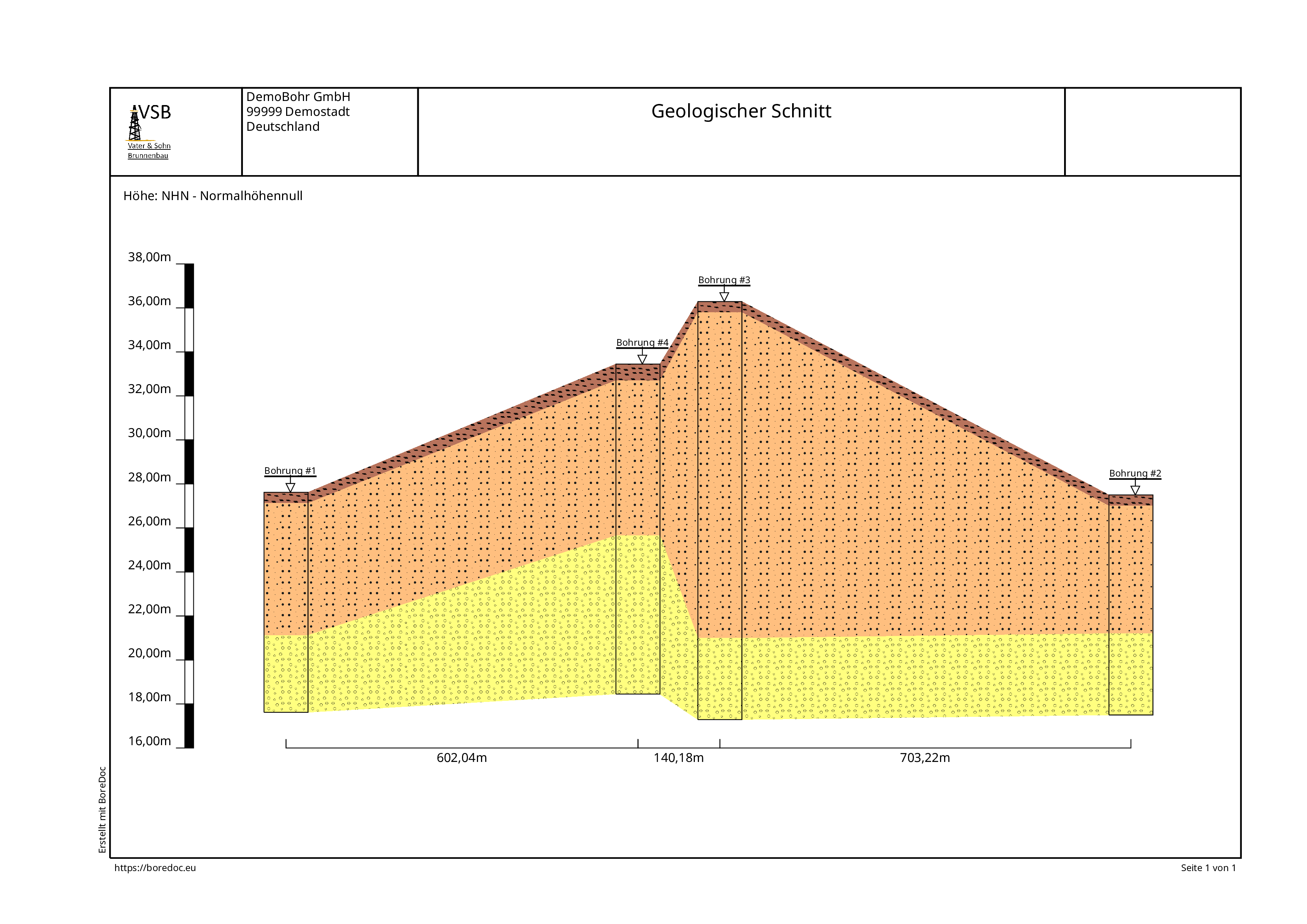
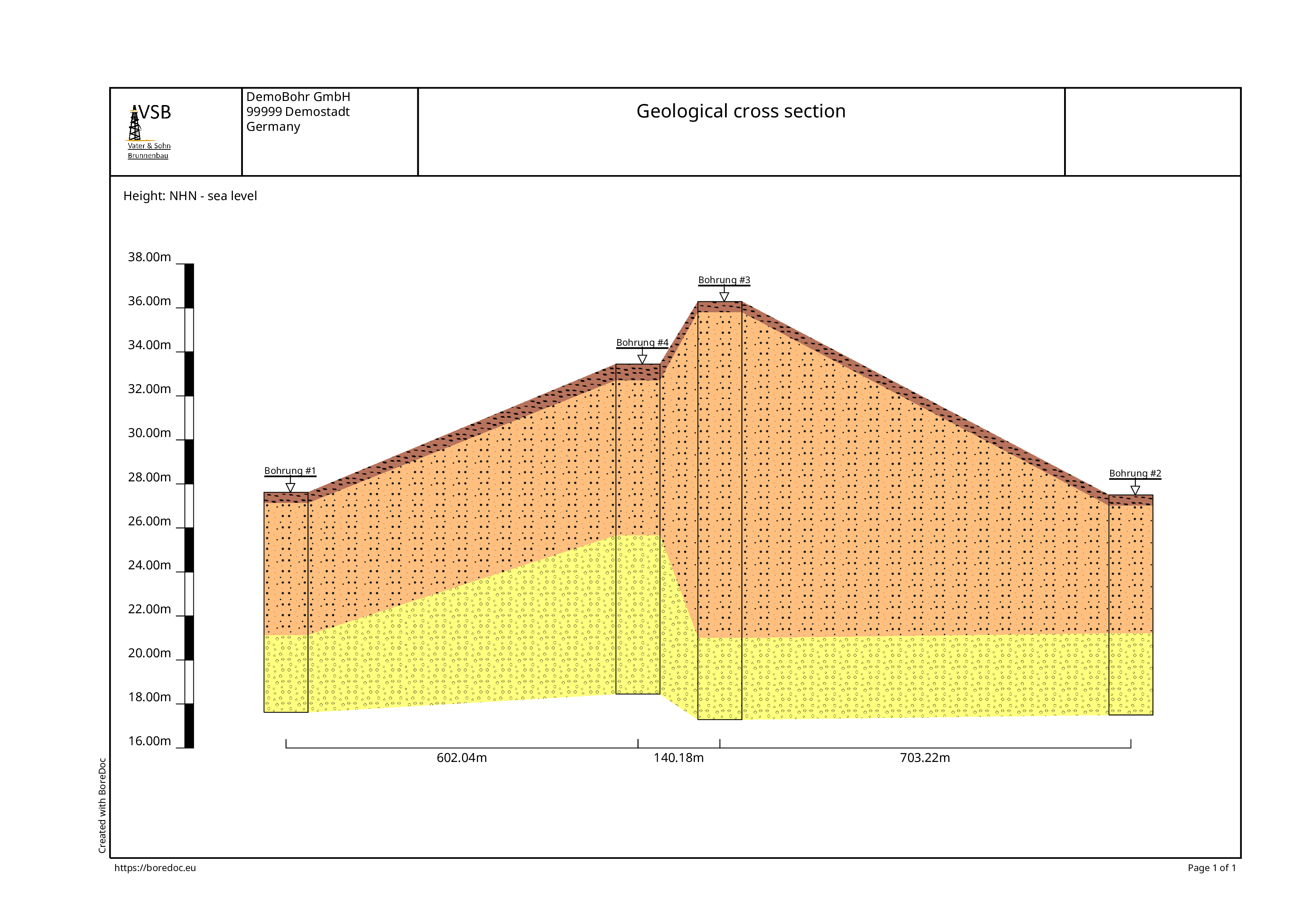
A geological cross-section illustrates the structure of the subsurface between several boreholes and enables a spatial interpretation of the geological conditions. It links the individual stratigraphic profiles to form a continuous representation and reveals relationships that cannot be discerned from individual boreholes alone. The aim is to provide a clear representation of the subsurface structure along a given stretch.
The geological cross-section is based on the stratigraphic logs of the boreholes involved, as well as their locations and elevation data. By linking the individual strata, a continuous picture of the subsurface is created, which allows conclusions to be drawn about stratigraphic sequences, thicknesses and geological structures.
Long text
In practice, the geological cross-section is used by geologists, engineers and consultants to assess ground conditions, validate planning and develop geological models. It is a key tool for site evaluation and risk assessment.
In BoreDoc, the geological cross-section is automatically generated from the available borehole data. The location of the boreholes is determined by their coordinates, whilst the stratigraphic sequences are derived from the structured data in the stratigraphic index. This results in a consistent and traceable representation without the need for additional modelling. A prerequisite is that the elevation data for all boreholes are in the same reference system.
Geological cross-sections are based on established methods of geological interpretation and are an essential component of ground investigation and environmental assessment.
=======
generated_at: "2026-07-27T10:28:14.483238900Z"
---
A geological cross-section illustrates the structure of the subsurface between several boreholes and enables a spatial interpretation of the geological conditions. It links the individual stratigraphic profiles into a continuous representation and reveals relationships that cannot be discerned from individual boreholes alone. The aim is to provide a clear representation of the subsurface structure over a given distance.
The geological cross-section is based on the stratigraphic records of the boreholes involved, as well as their locations and elevation data. By linking the individual strata, a continuous picture of the subsurface is created, which allows conclusions to be drawn about stratigraphic trends, thicknesses and geological structures.
Long text
In practice, the geological cross-section is used by geologists, engineers and consultants to assess ground conditions, validate planning and develop geological models. It is a key tool for site evaluation and risk assessment.
In BoreDoc, the geological cross-section is automatically generated from the available borehole data. The location of the boreholes is determined by their coordinates, whilst the stratigraphic sequences are derived from the structured data in the stratigraphic index. This results in a consistent and traceable representation without the need for additional modelling. A prerequisite is that the elevation data for all boreholes are in the same reference system.
Geological cross-sections are based on established methods of geological interpretation and form an essential part of site investigation and environmental assessment.
>>>>>>> branch 'master' of git@github.com:mschulzeondts/boredoc-content.git
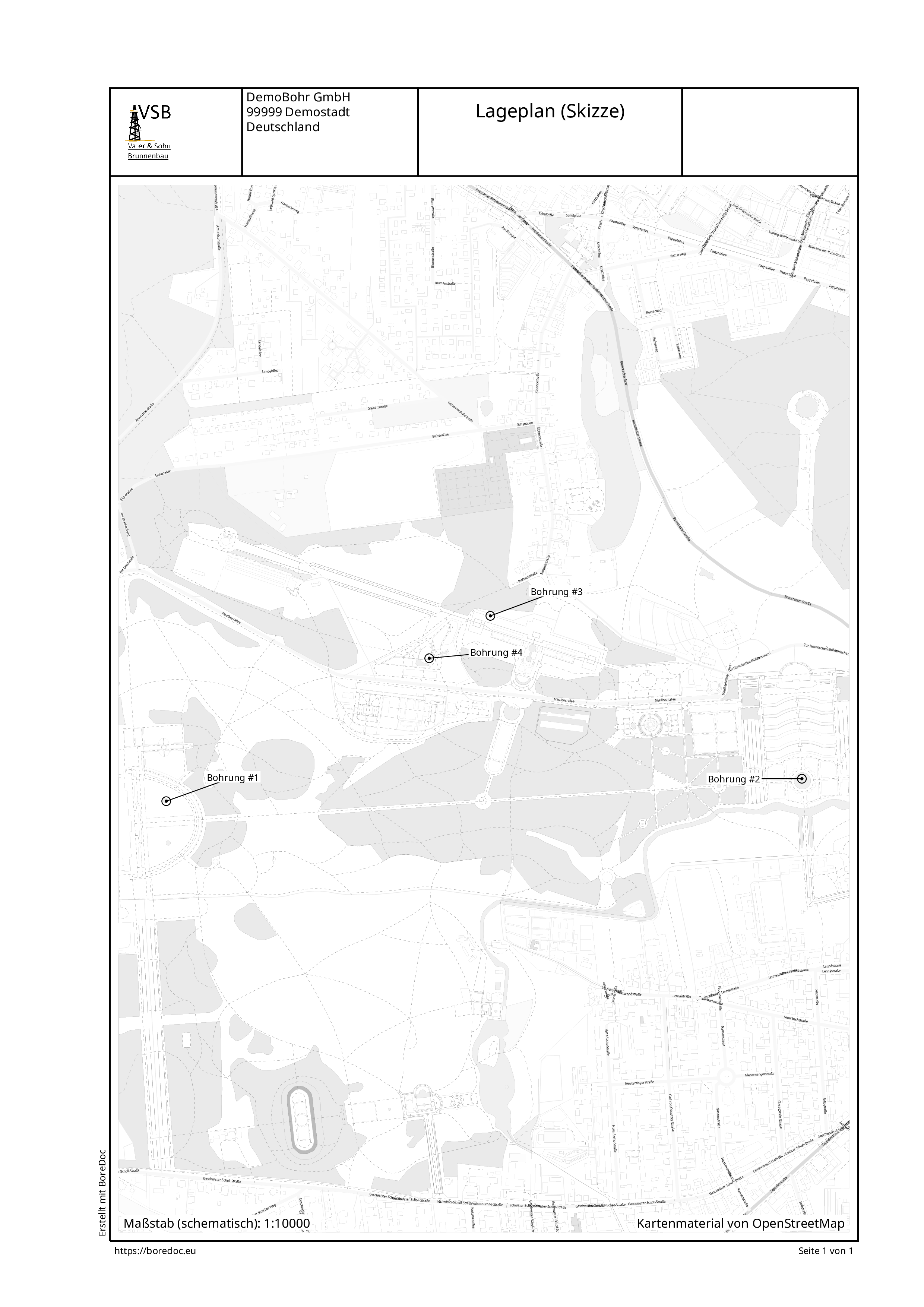
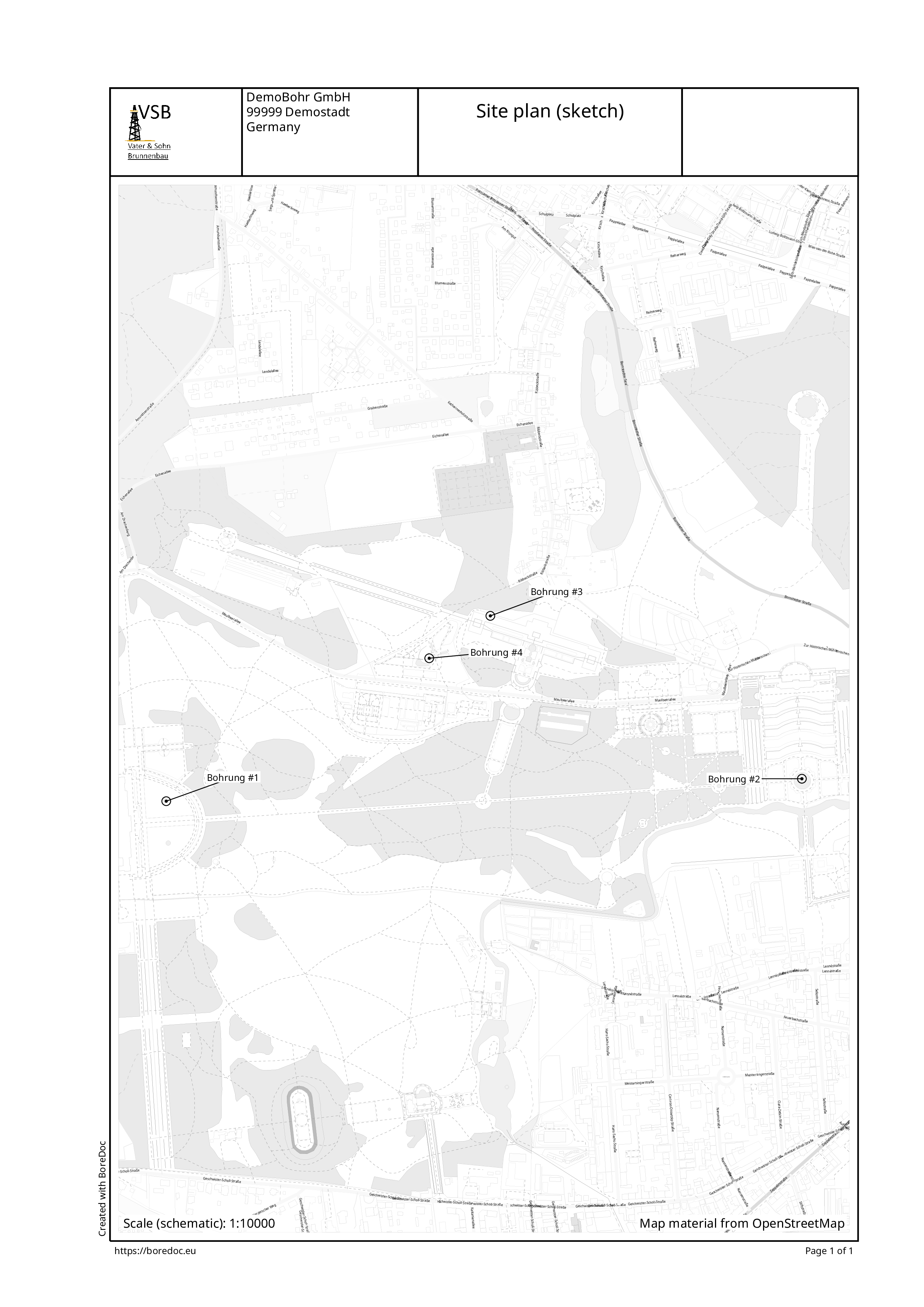
A site plan shows the spatial position of boreholes within a project and enables them to be clearly identified in the field. It serves as a guide and shows the position of the individual boreholes in relation to one another and to the surrounding area. The aim is to provide a clear and comprehensible representation of the local situation.
The site plan is based on the geographical coordinates of the boreholes. These are displayed on a map background so that both the relative position of the boreholes and their integration into the terrain are clearly visible. Depending on the layout, the representation can depict both large-scale relationships and detailed areas.
Long text
In practice, the site plan is used by planners, site managers and public authorities to uniquely identify the positions of boreholes and to cross-reference them with other planning documents. It is an essential document for coordination on site, as well as for documentation and record-keeping.
=======
generated_at: "2026-07-27T10:28:16.733086500Z"
---
A site plan shows the spatial position of boreholes within a project and enables them to be clearly identified in the field. It serves as a guide and shows the position of the individual boreholes in relation to one another and to the surrounding area. The aim is to present the local situation in a clear and comprehensible manner.
The site plan is based on the geographical coordinates of the boreholes. These are plotted on a map background so that both the relative position of the boreholes and their integration into the terrain are clearly visible. Depending on the layout, the representation can depict both large-scale contexts and detailed areas.
Long text
In practice, the site plan is used by planners, site managers and authorities to uniquely identify the positions of boreholes and to cross-reference them with other planning documents. It is an essential document for coordination on site, as well as for documentation and record-keeping.
>>>>>>> branch 'master' of git@github.com:mschulzeondts/boredoc-content.git
In BoreDoc, the site plan is automatically generated from the coordinates of the boreholes at a drilling site. Different coordinate formats are standardised and displayed correctly. The map section is automatically selected so that all boreholes are clearly visible. Where boreholes are closely spaced, a combined overview and detailed view can also be generated.
The display is based on established cartographic principles and supports the consistent and traceable documentation of drilling points in the field.
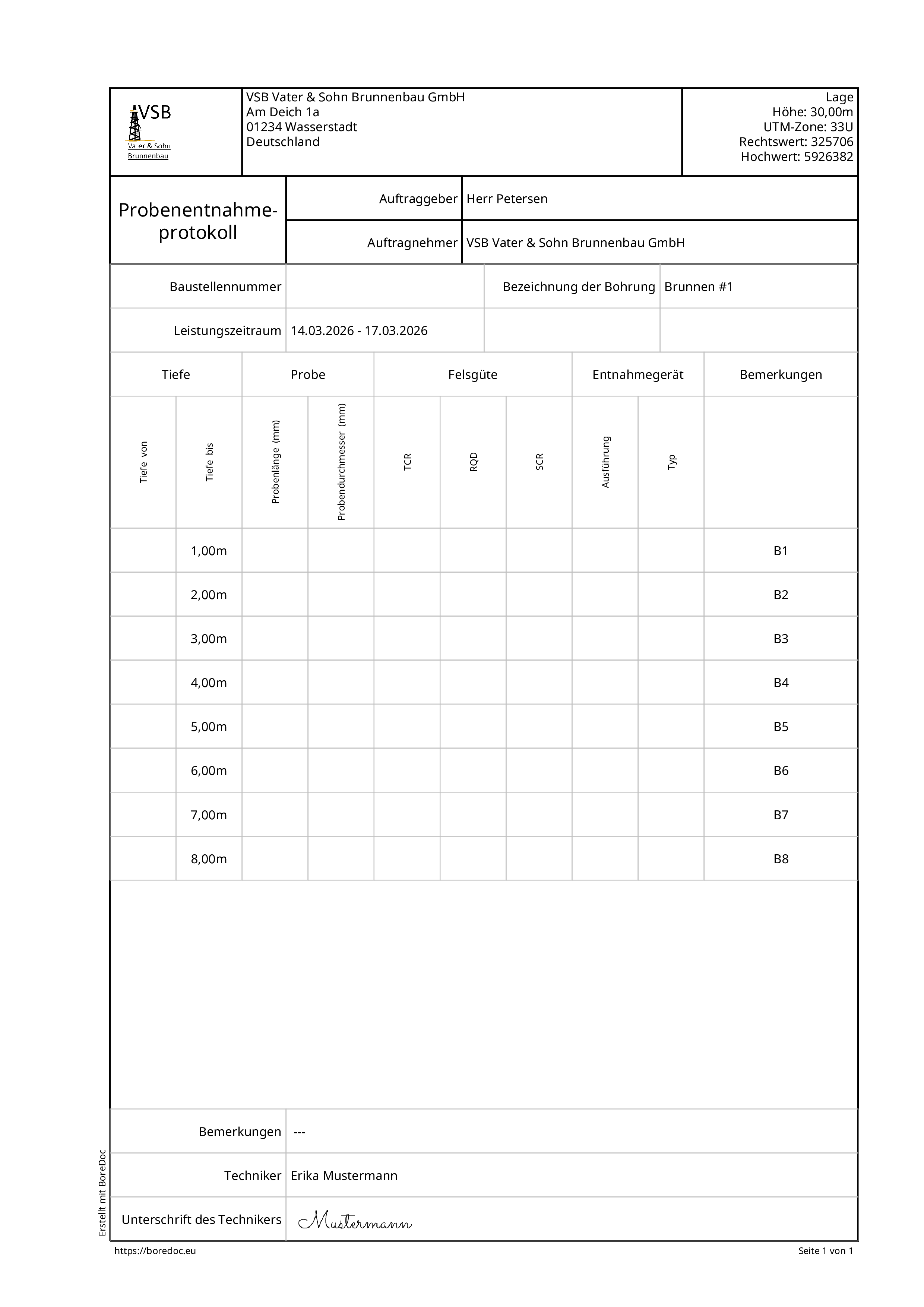
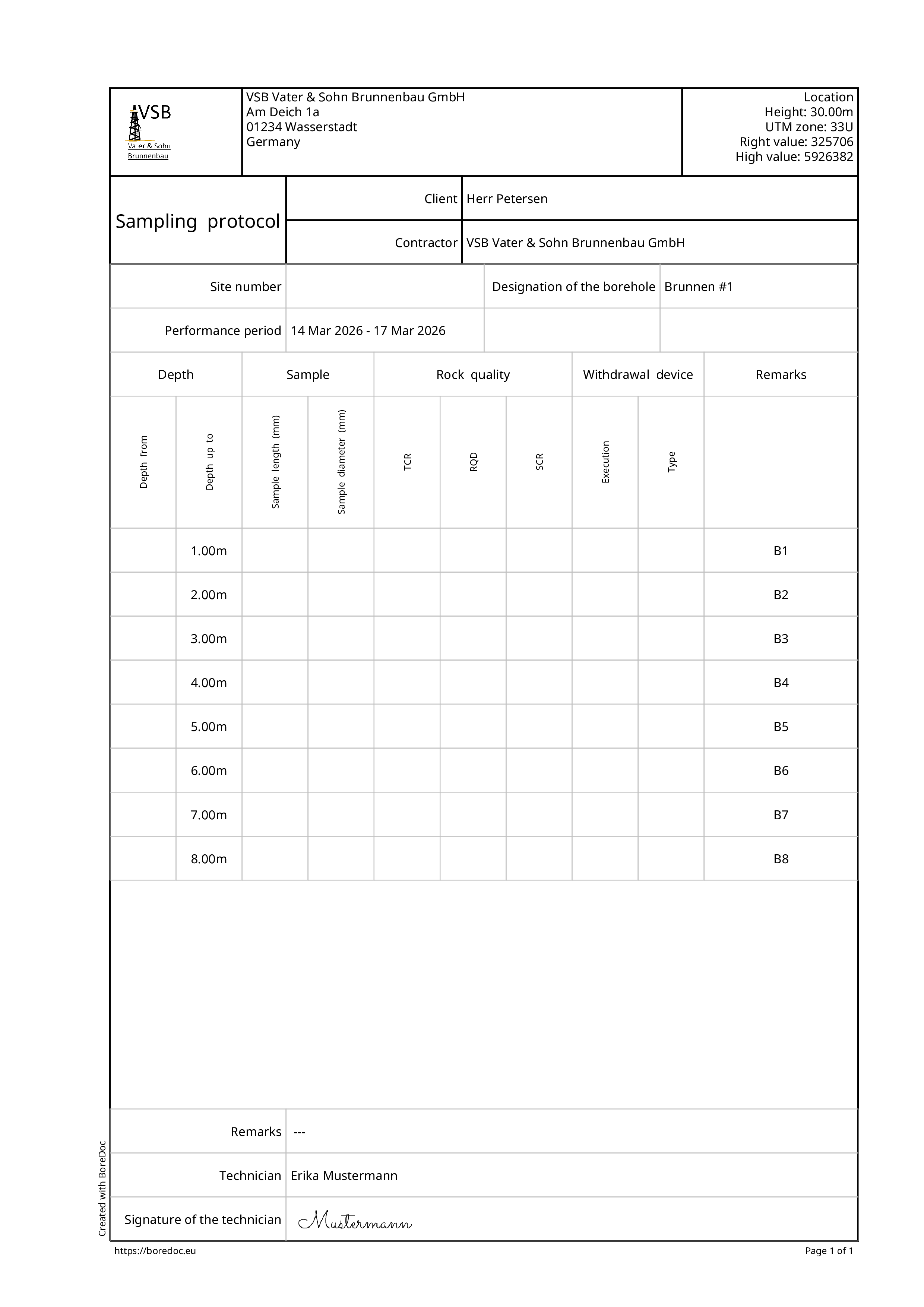
A sampling report documents the collection of soil and rock samples during a borehole drilling operation and ensures that they can be clearly identified. It records the depth from which a sample was taken and the conditions under which it was collected. It thus forms the basis for the traceable further processing and analysis of the samples.
The log records all samples taken, along with their key characteristics. These include the unique identification, the depth at which the sample was taken and the type of sample. Additionally, information on the condition, size or any particular characteristics may be recorded. This structured recording enables consistent and clear documentation throughout the entire borehole.
Long text
The sampling log is of central importance for practical application, as it establishes the link between on-site sampling and subsequent analysis in the laboratory. Test results can be clearly assigned to the respective depths and sampling points. This creates a reliable basis for geotechnical assessments and subsequent decision-making.
Furthermore, the log serves an important evidential function. It documents that sampling has been carried out professionally and supports transparent communication with clients, testing bodies and authorities.
In BoreDoc, the sampling report is generated automatically from the recorded sample data. Data is entered centrally in the sample directory, and all information is transferred directly into the document. This reduces the effort involved in data entry and ensures that the documentation is consistent and up to date at all times.
The execution and documentation of sampling are based on applicable standards and guidelines. In particular, DIN EN ISO 22475 sets out requirements for geotechnical investigations and ensures a standardised and professional approach to sampling and its documentation.
=======
generated_at: "2026-07-27T10:28:19.569019900Z"
---
A sampling log documents the collection of soil and rock samples during a borehole operation and ensures that they can be clearly identified. It records the depth from which a sample was taken and the conditions under which it was collected. It thus forms the basis for the traceable further processing and analysis of the samples.
The log records all samples taken, along with their key characteristics. These include the unique identification, the depth at which the sample was taken and the type of sample. Additionally, information on the condition, size or any particular features may be recorded. This structured recording enables consistent and clear documentation throughout the entire borehole.
Long text
The sampling log is of central importance for practical application, as it establishes the link between on-site sampling and subsequent analysis in the laboratory. Test results can be clearly assigned to the respective depths and sampling points. This provides a reliable basis for geotechnical assessments and subsequent decision-making.
Furthermore, the log serves an important evidential function. It documents that sampling has been carried out in accordance with best practice and supports transparent communication with clients, testing bodies and regulatory authorities.
In BoreDoc, the sampling report is generated automatically from the recorded sample data. Data is entered centrally in the sample register, and all information is transferred directly into the document. This reduces the effort involved in data entry and ensures that the documentation is consistent and up to date at all times.
The sampling process and its documentation are based on applicable standards and guidelines. In particular, DIN EN ISO 22475 sets out requirements for geotechnical investigations and ensures a standardised and professional approach to sampling and its documentation.
>>>>>>> branch 'master' of git@github.com:mschulzeondts/boredoc-content.git
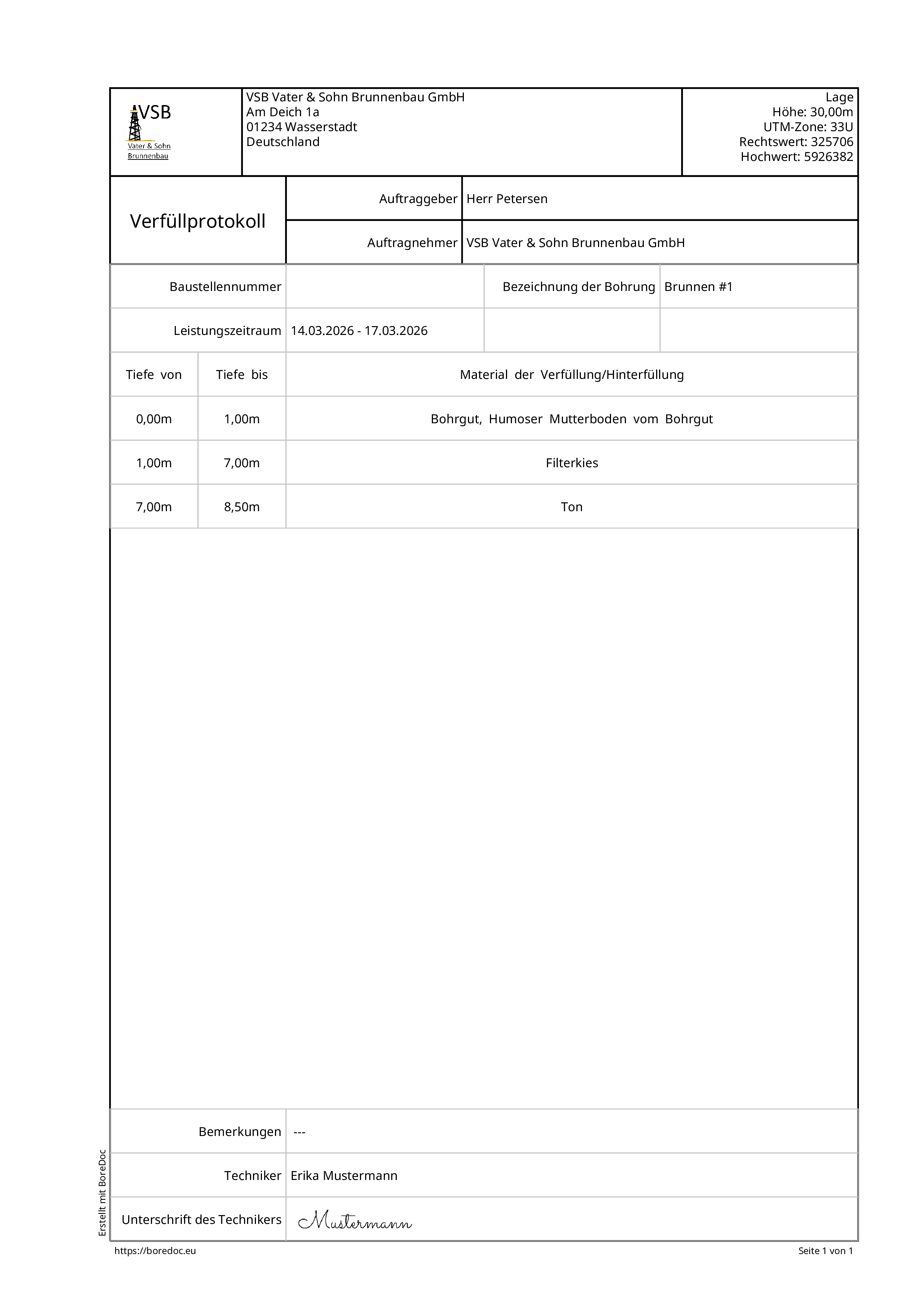
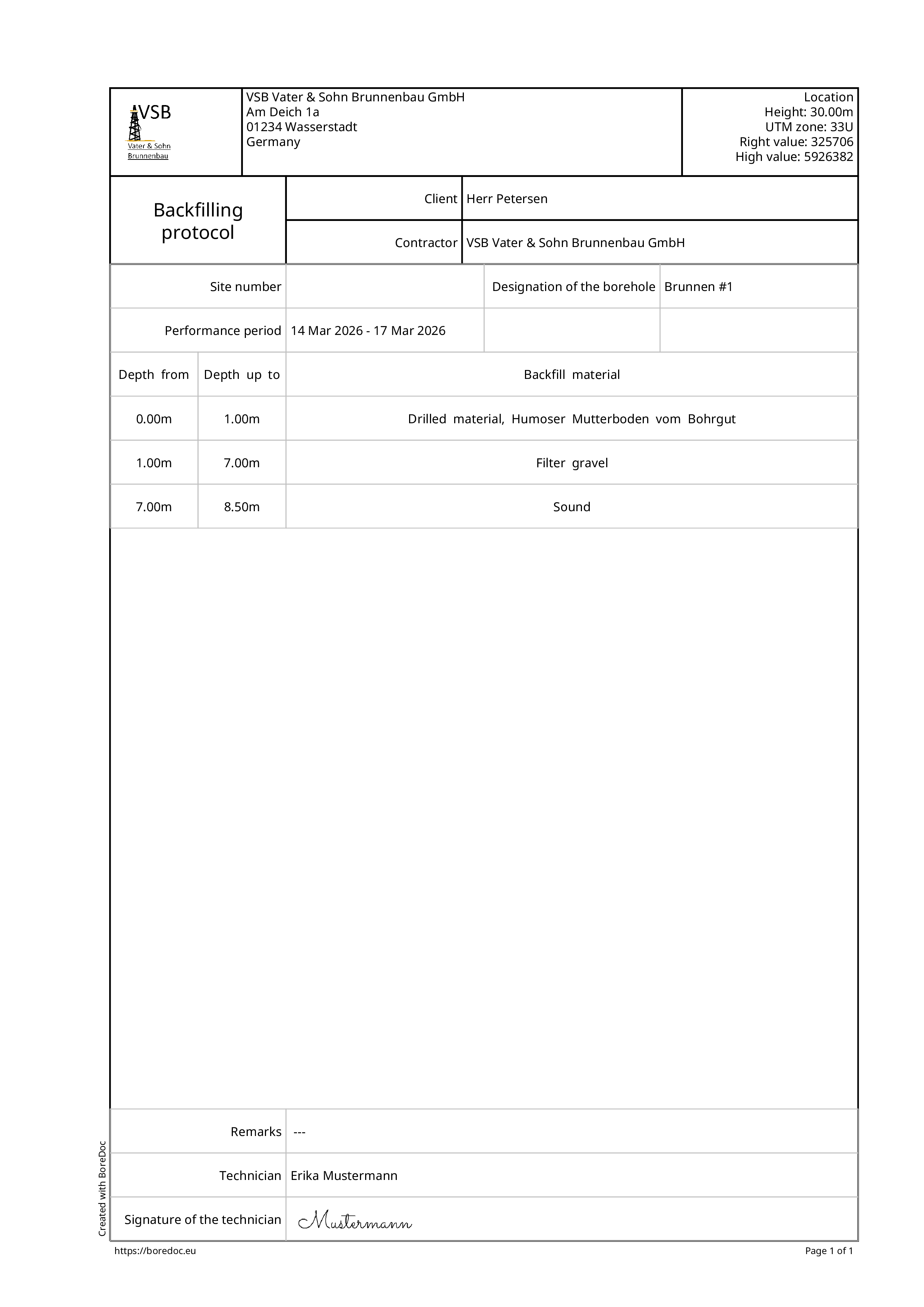
The backfilling log documents the final stages of a borehole and describes which materials were placed in which sections of the borehole. It records the final condition upon completion of the work and ensures a transparent and traceable record of the backfilling process.
The report is based on the allocation of backfill materials to defined depth intervals. Materials such as filter gravel, clay or special sealing compounds are recorded according to their location in the borehole. This structured record makes it possible to clearly trace the composition of the backfill across the entire depth.
Long text
In practice, the backfill report is an important document for quality assurance and as evidence of proper execution. It is used by clients, authorities and surveyors to verify compliance with technical and water law requirements. Particular focus is placed on the sealing and protection of aquifers.
Furthermore, the log provides a reliable basis for subsequent work on the borehole. Information on the structure of the backfill is crucial when planning maintenance work, modifications or decommissioning.
In BoreDoc, the backfill report is automatically generated from the recorded backfill sections. The relevant data is entered once and transferred directly into the document. Changes are incorporated without any additional effort, ensuring that the documentation remains up to date and consistent at all times.
The documentation is based on the applicable technical regulations and legal requirements. These ensure that backfilling is carried out professionally and that it fulfils its function – particularly with regard to sealing and the protection of groundwater – on a long-term basis.
=======
generated_at: "2026-07-27T10:28:21.853805Z"
---
The backfilling report documents the final stages of a borehole and describes which materials were placed in which sections of the borehole. It reflects the final condition upon completion of the work and ensures a transparent and traceable record of the backfilling.
The report is based on the allocation of backfill materials to defined depth intervals. Materials such as filter gravel, clay or special sealing compounds are recorded according to their location in the borehole. This structured record makes it possible to clearly trace the composition of the backfill across the entire depth.
Long text
In practice, the backfill report is an important document for quality assurance and as evidence of proper execution. It is used by clients, authorities and surveyors to verify compliance with technical and water law requirements. Particular focus is placed on the sealing and protection of aquifers.
Furthermore, the log provides a reliable basis for subsequent work on the borehole. Information on the backfill structure is crucial when planning maintenance work, modifications or decommissioning.
In BoreDoc, the backfill report is automatically generated from the recorded backfill sections. The relevant data is entered once and transferred directly into the document. Changes are incorporated without any additional effort, ensuring that the documentation remains up to date and consistent at all times.
The documentation complies with the applicable technical regulations and legal requirements. These ensure that backfilling is carried out professionally and that it fulfils its function – particularly with regard to sealing and the protection of groundwater – on a long-term basis.
>>>>>>> branch 'master' of git@github.com:mschulzeondts/boredoc-content.git
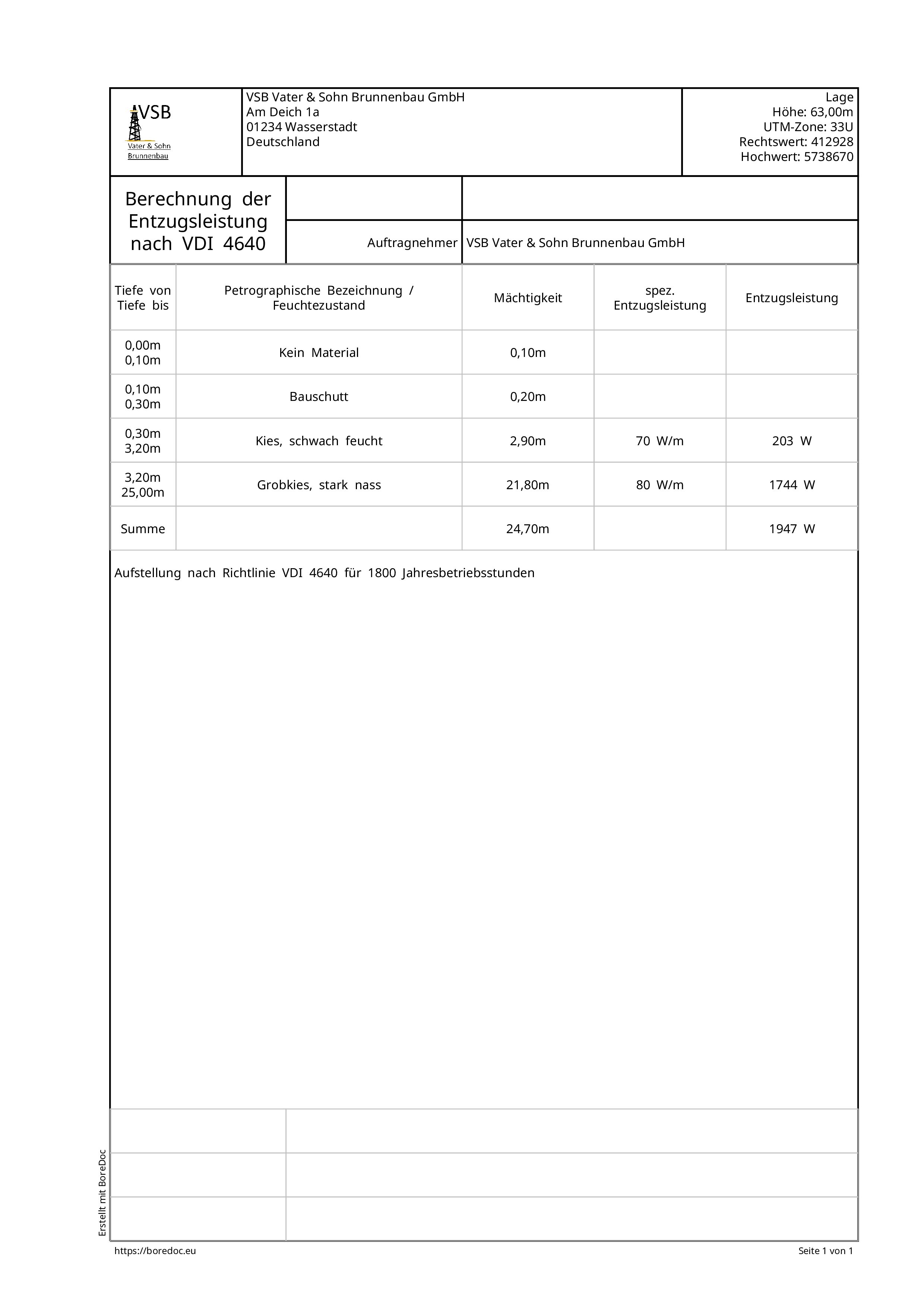
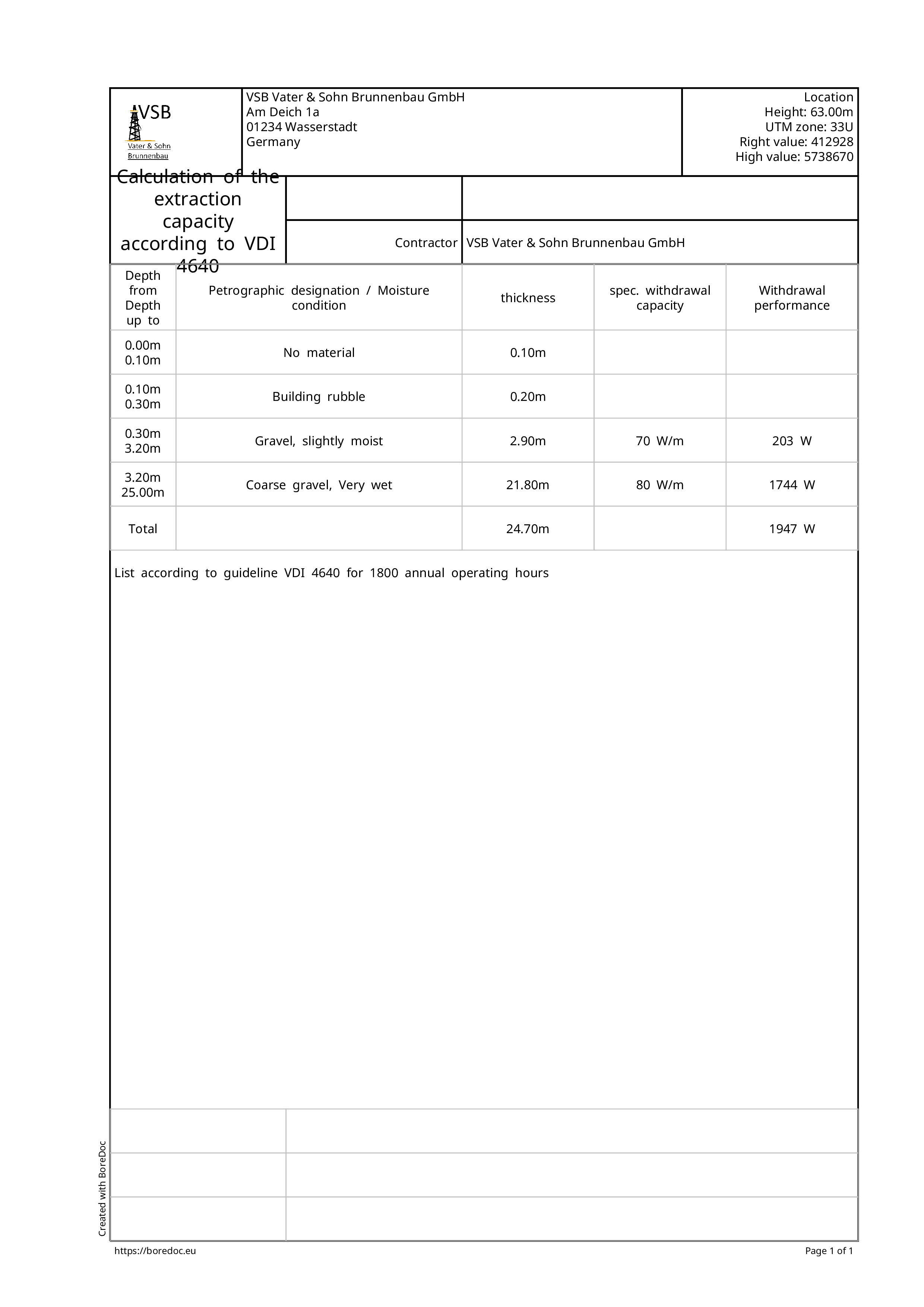
The calculation in accordance with VDI 4640 is used for the systematic assessment of the heat extraction capacity of geothermal boreholes. It provides an essential basis for the planning and design of geothermal systems by linking geological data with established guideline values. The aim is to estimate the energy potential of the subsoil in a transparent and reliable manner.
The starting point for the calculation is the division of the subsoil into individual layers with defined properties. For each of these layers, a specific heat extraction capacity is assigned, based on the specifications of VDI 4640. By aggregating these values across the entire borehole depth, an overall assessment is produced, which serves as the basis for the system’s design.
Long text
In practice, this method assists specialist planners, engineers and regulatory authorities in assessing sites and designing geothermal probes. It helps to ensure compliance with regulatory requirements and to guarantee the efficient and sustainable use of geothermal resources.
In BoreDoc, the calculation is carried out directly on the basis of the recorded stratum data. The necessary information is available without any additional effort and is automatically integrated into the assessment. Suitable reference values can be stored or suggested for each stratum, ensuring that the calculation remains consistent and up to date at all times.
=======
generated_at: "2026-07-27T10:28:11.203826100Z"
---
The calculation in accordance with VDI 4640 is used for the systematic assessment of the heat extraction capacity of geothermal boreholes. It provides an essential basis for the planning and design of geothermal systems by linking geological data with specified reference values. The aim is to estimate the energy potential of the subsurface in a transparent and reliable manner.
The starting point for the calculation is the division of the subsurface into individual layers with defined properties. For each of these layers, a specific heat extraction capacity is assigned, based on the specifications of VDI 4640. By aggregating these values across the entire borehole depth, an overall assessment is produced which serves as the basis for the design of the system.
Long text
In practice, this method assists specialist planners, engineers and regulatory authorities in assessing sites and designing geothermal probes. It helps to ensure compliance with regulatory requirements and to guarantee the efficient and sustainable use of geothermal resources.
In BoreDoc, the calculation is carried out directly on the basis of the recorded stratigraphic data. The necessary information is available without any additional effort and is automatically integrated into the assessment. Suitable reference values can be stored or suggested for each stratum, ensuring that the calculation remains consistent and up to date at all times.
>>>>>>> branch 'master' of git@github.com:mschulzeondts/boredoc-content.git
The basis for this is the VDI 4640 guideline, which is recognised as the standard for the planning, execution and assessment of geothermal systems. It ensures a uniform methodology and enables a comparable and professional assessment of the thermal performance of boreholes.
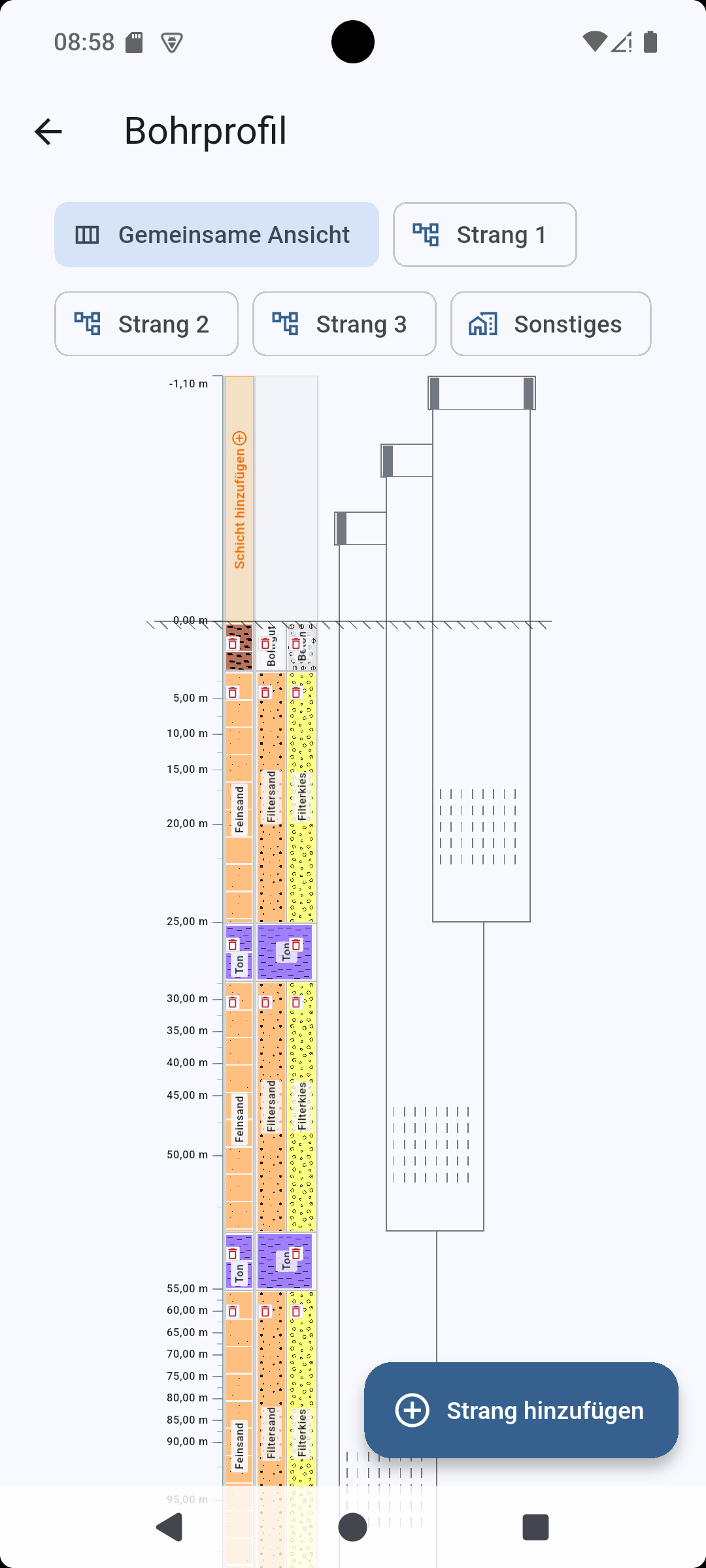
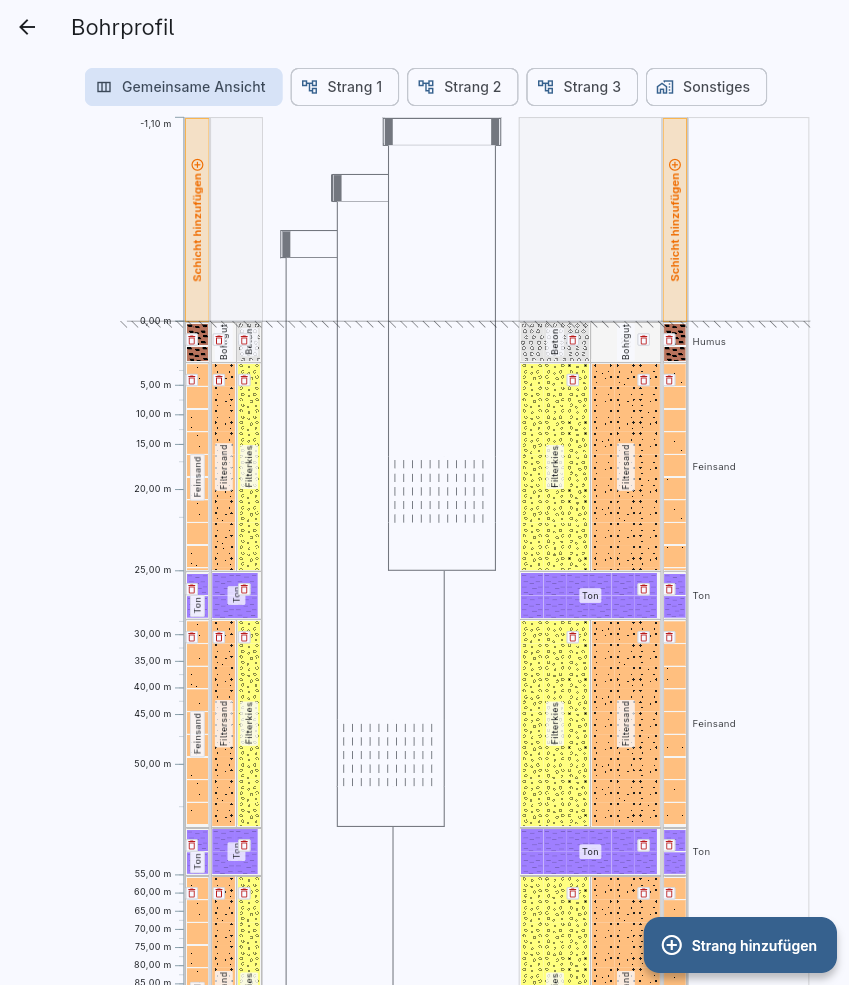
The borehole at a glance
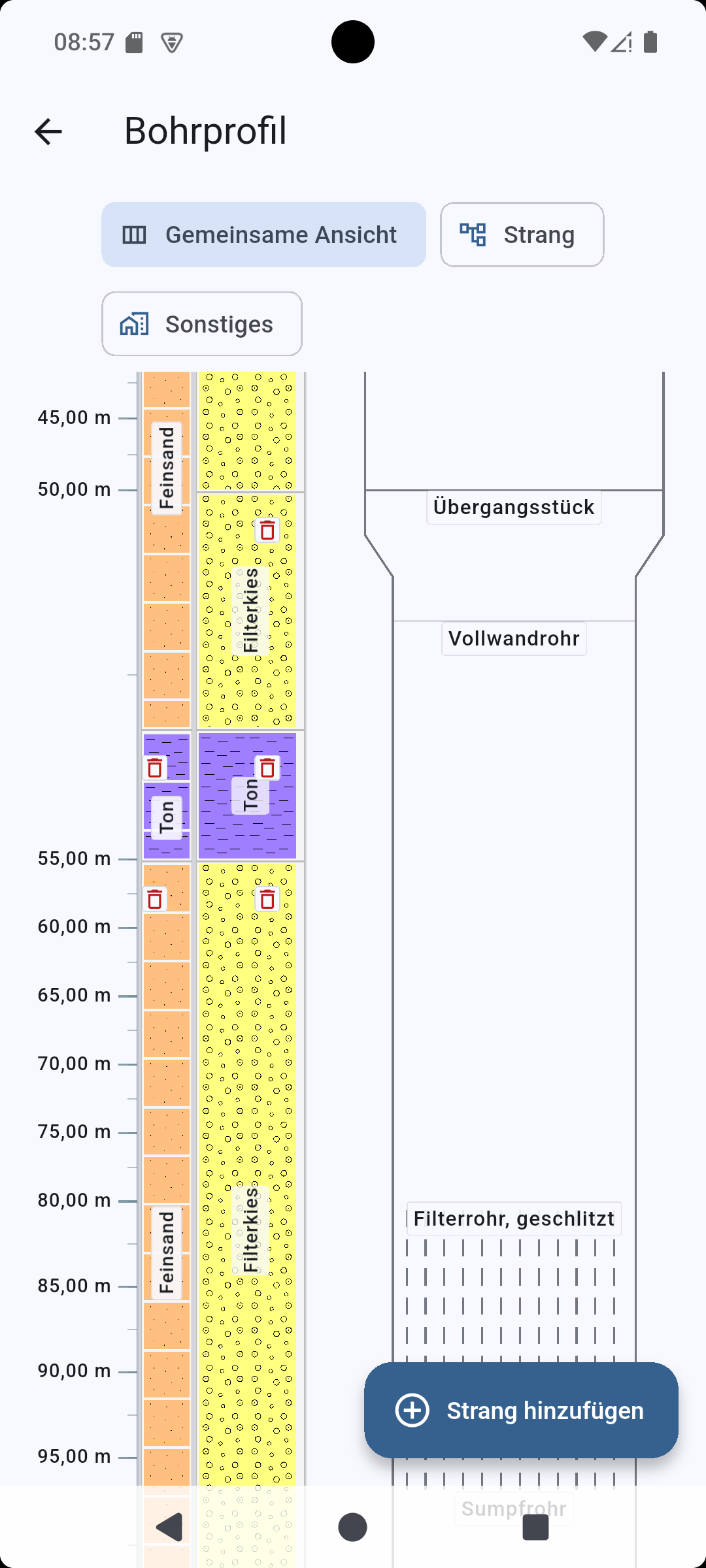
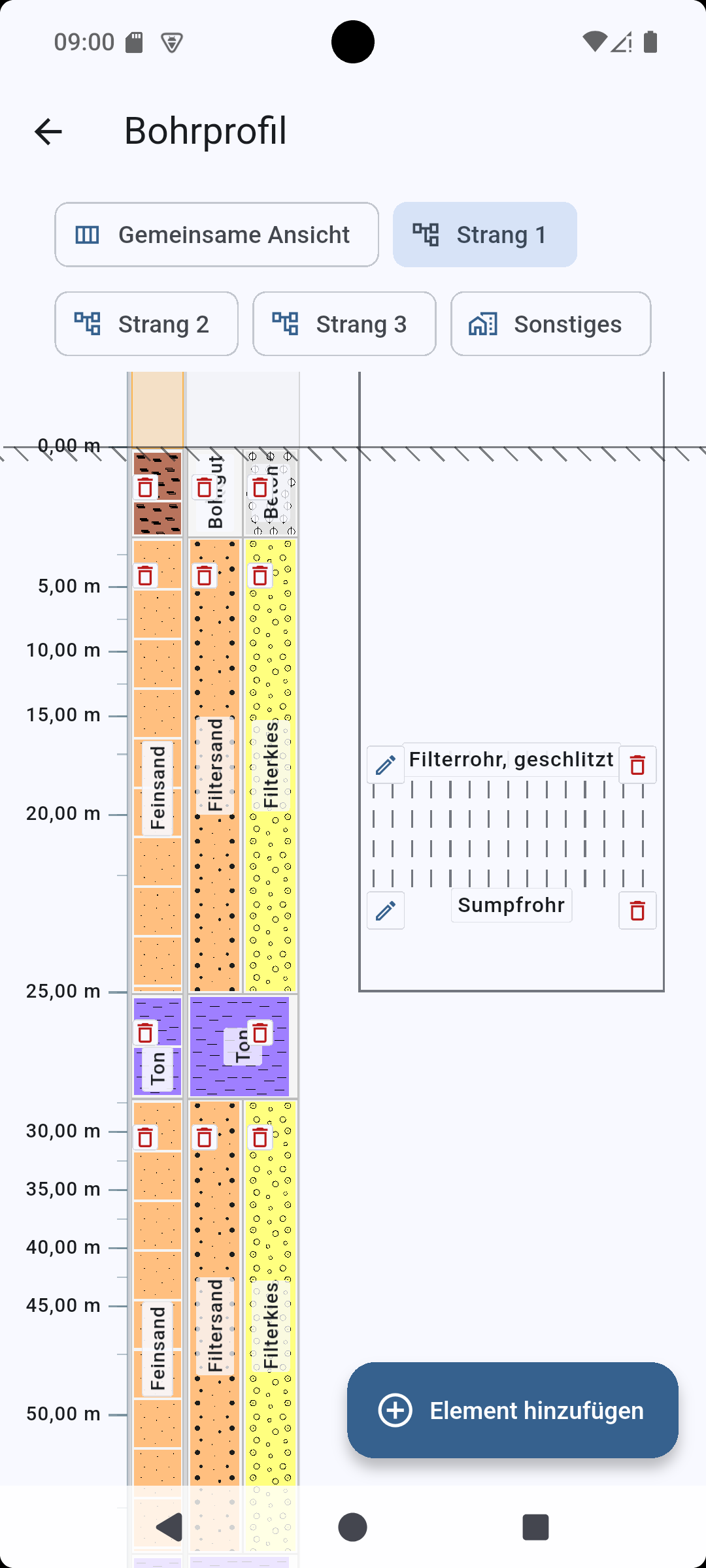
The view borehole profile clearly shows the structure of a borehole along its depth. This allows you to quickly identify the composition of the subsoil and the technical components that make up the borehole.
Edit data where it belongs
The various sections of the display guide you through the key details: strata, backfill and lining are clearly arranged side by side. Clicking on an area opens the relevant input fields directly within the view.
This allows you to keep track of the relationship between depth, ground structure and technical design, even when a borehole contains a large number of individual details.
Notes directly within the view
BoreDoc checks the entered details and displays notes and errors directly in the relevant section. This allows you to see quickly where details are still missing or where values do not match.
The software assumes that you wish to enter the data as completely as possible. Therefore, notes may appear if details have not yet been entered. This is not automatically an error: the notes help you to gradually complete the documentation.
A clear overview for further documentation
The borehole profile view combines data entry with an overview. Changes to the data remain visible in context and form a reliable basis for further processing and the subsequent creation of documents.
A detailed explanation of the individual sections and steps can be found in the separate help section for borehole profile.
If you have any questions or suggestions regarding data protection, you are welcome to contact us via the Contact form contact us.
We take the protection of your personal data very seriously. Personal data is any data that can be used to identify you personally. This privacy policy informs you about what data we collect, how we use it and what rights you have - both when using the boredoc.eu website and when using our BoreDoc app.
When you access our website, your device automatically transmits data for technical reasons. The following data is stored separately from other data that you may transmit to us:
We store this data for the following purposes:
Your IP address is only stored for a period of 90 days.
Legal basis: Art. 6 para. 1 lit. f GDPR (legitimate interest).
This website uses Google Analytics (Google Ireland Ltd., Dublin, Ireland).
Data collected: IP address (shortened), usage behaviour, device data
Purpose: Improvement of our offer
Legal basis: Art. 6 para. 1 lit. a GDPR (consent)
Data transfer: if applicable, third countries (e.g. USA) in accordance with EU standard contractual clauses
You can revoke your consent at any time or change it via our cookie banner.
Embedded videos from YouTube (Google Ireland Ltd.) can be displayed on our website. Your IP address is transmitted to Google when loading.
Purpose: Provide multimedia content
Legal basis: Art. 6 para. 1 lit. a GDPR (consent)
Our app uses Google Firebase. Services used:
The BoreDoc app works offline for the most part. Only certain functions such as synchronisation, QR code sharing and creating documents use a server connection.
We may use external providers within the EU for hosting and API operation.
You have the right to:
We reserve the right to amend this privacy policy in order to adapt it to changed legal situations or technical developments. The current version is available at Data protection retrievable.